Writers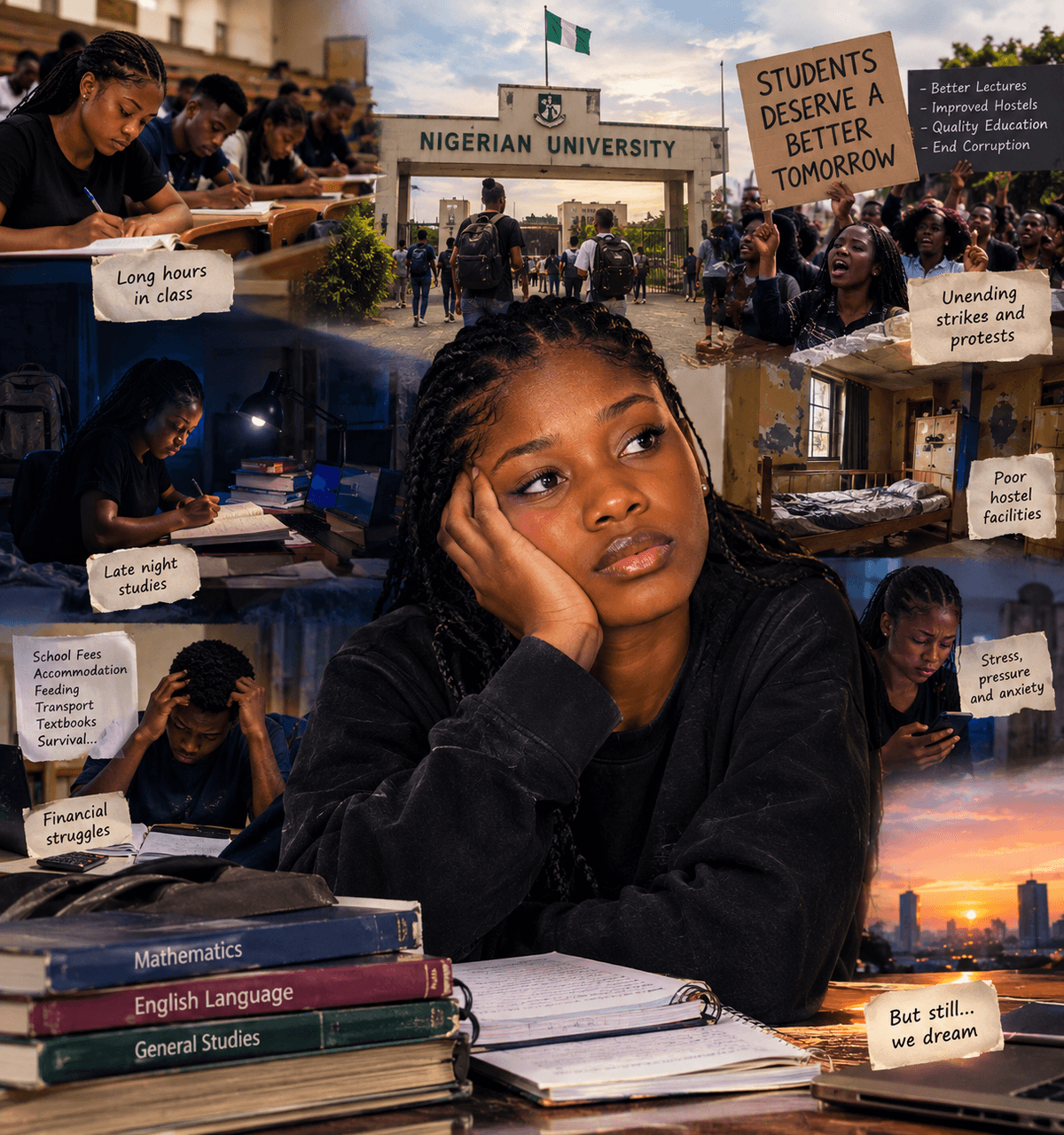
The Price of the Dream
Every morning, thousands of Nigerian students wake up with one thing on their minds: “I must make it.”
For many students, university is more than a place to study. It is a journey filled with sacrifice, uncertainty, pressure, friendship, disappointment, and hope. Behind every student carrying a backpack is a story that most people may never hear.
Amaka was one of them.
She was a university student with a simple dream. She wanted to graduate, get a good job, support her family, and one day look back and say, “Everything I went through was worth it.”
But getting there was not easy.
Her day usually began before sunrise. She would prepare for lectures, sometimes without enough food in her stomach, and rush to class because she knew that arriving late could mean standing throughout the lecture.
The classrooms were often crowded. Sometimes there were not enough seats, and students had to squeeze together just to listen to their lecturers.
After lectures came assignments, presentations, tests, and projects.
Then there was the financial pressure.
School fees had to be paid. Accommodation cost money. Transportation cost money. Food became more expensive. Textbooks, printing, internet data, practical materials, and other academic expenses continued to add up.
Amaka often looked at the money in her account and wondered how she would survive until the end of the month.
She knew her parents were trying their best, but she also knew that they had their own responsibilities.
So she learned to manage what she had.
Sometimes she walked instead of taking transportation. Sometimes she skipped buying something she wanted because she needed the money for photocopies. Sometimes she would sit with her friends and they would combine the little money they had to buy food.
They laughed together, but behind some of those laughs was worry.
Then there were hostel problems.
Some students lived in crowded rooms with several roommates. Water could become a problem. Electricity was not always reliable. Privacy was limited, and finding a quiet place to study could feel like searching for a hidden treasure.
Yet somehow, students still opened their books.
They studied under difficult conditions.
They stayed awake late into the night preparing for examinations.
And sometimes, just when they were beginning to settle into the academic calendar, another disruption would come.
A strike.
A protest.
A university closure.
A delayed examination.
A postponed semester.
For some students, the delay meant more than losing time. It meant spending extra money on accommodation and feeding while waiting for school to resume. It meant uncertainty about graduation and frustration about plans that had been put on hold.
Amaka sometimes became exhausted.
One night, after returning from a long day, she dropped her bag beside her bed and stared at her books.
She didn't want to study.
She didn't want to think.
She simply wanted everything to become easier.
Then her phone rang.
It was her mother.
“Have you eaten?” her mother asked.
Amaka smiled.
“Yes, Mum.”
It wasn't completely true, but she didn't want her mother to worry.
Her mother continued, “Don't give up, my daughter. We didn't send you to school because we expect the journey to be easy. We sent you because we believe you can finish it.”
Those words stayed with Amaka.
The next morning, she woke up with a different kind of determination.
She realised that she was not the only student struggling.
All around her were young people carrying dreams bigger than their circumstances.
There was the student working part-time to pay his school expenses.
There was the girl studying medicine while worrying about how her family would afford the next semester.
There was the student who travelled several hours to attend lectures.
There was the final-year student desperately trying to complete a project after years of delays.
There were students who cried privately but still showed up to class the next morning.
They were tired.
They were frustrated.
But they kept going.
Because Nigerian students have something powerful: resilience.
They learn to adapt.
They learn to survive with little.
They learn to turn difficult situations into opportunities.
They learn to encourage one another.
And most importantly, they continue to dream.
Years later, Amaka stood in her graduation gown.
As she looked around at her classmates, she remembered the crowded classrooms, the sleepless nights, the financial struggles, the difficult semesters, the delayed plans, and all the moments when she almost gave up.
She remembered the girl who once wondered whether she would make it.
Now, she was standing at the finish line.
Her eyes filled with tears.
Not because the journey had been easy, but because she had survived it.
She understood that her degree was more than a certificate.
It represented every sacrifice.
Every late night.
Every difficult morning.
Every “I don't have enough.”
Every “try again.”
Every moment she chose to continue.
And as she walked across the stage, she smiled.
Because she knew something that no textbook could teach her:
Education is not only about what you learn in the classroom. Sometimes, it is also about learning how strong you can become when life refuses to make things easy.
The journey of a Nigerian student may be difficult, but behind the struggle are millions of young people carrying dreams for themselves, their families, and their country.
They may face obstacles.
They may experience delays.
They may question themselves.
But they continue.
They study.
They struggle.
They hope.
They rise.
And one day, when they finally reach the place they dreamed about, they will look back and realise that every difficult step helped shape the person they became.
Because behind every Nigerian student is not just a student.
There is a dreamer, a fighter, a survivor, and a future waiting to be built.