 Writers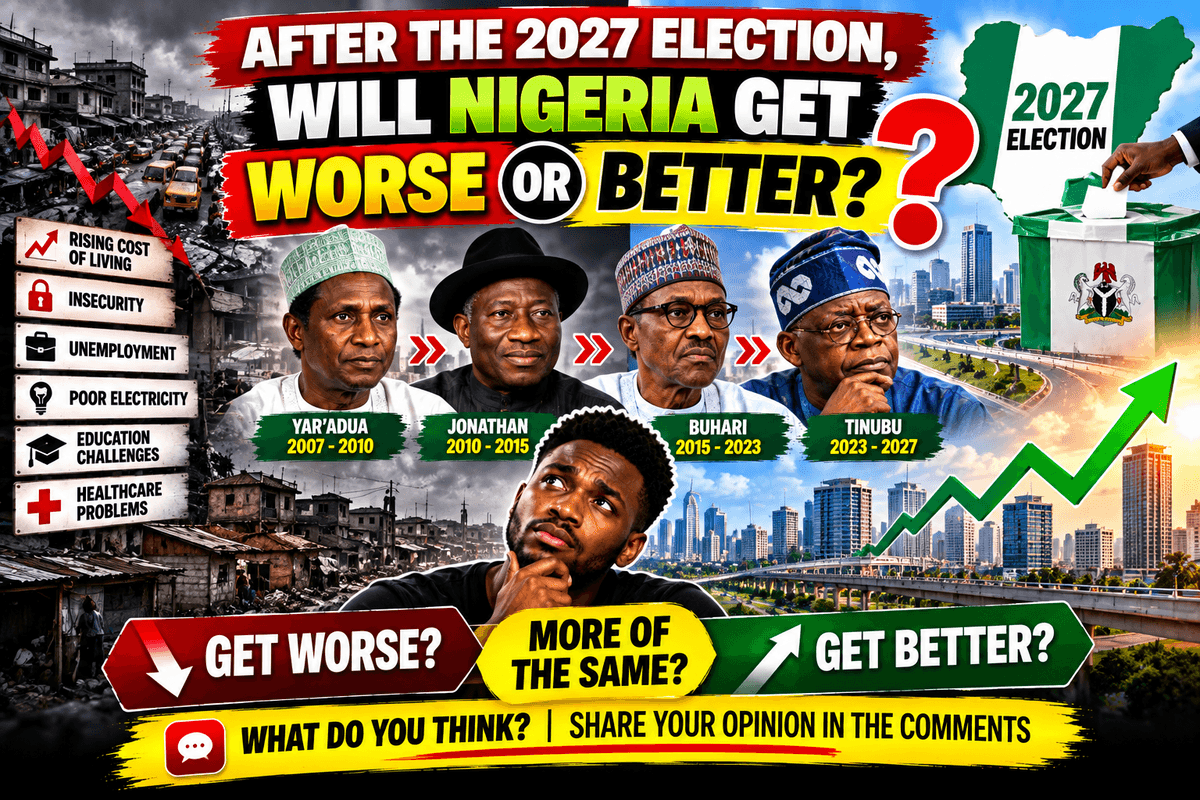
After the 2027 Election, Will Nigeria Get Better or Worse?
Since the administration of President Umaru Musa Yar’Adua, Nigeria has experienced several changes in political leadership. After Yar’Adua came Goodluck Jonathan, followed by Muhammadu Buhari, and then Bola Ahmed Tinubu. Each administration came with its own promises, policies and expectations.
Yet, after every transition, many Nigerians continue to ask the same question: Are we actually moving forward?
For many citizens, the feeling is that the country has become increasingly difficult to live in. The cost of food, transportation, housing and other basic necessities has placed pressure on families. Young people continue to search for employment opportunities, while insecurity remains a concern in different parts of the country.
But is it fair to say that Nigeria has become worse after every administration?
That question deserves a serious discussion.
From Yar’Adua to Jonathan
The Yar’Adua administration came into office in 2007 with promises of reforms and development. His administration introduced the idea of a seven-point agenda and was associated with efforts toward electoral reform and the Niger Delta amnesty programme.
After Yar’Adua's death in 2010, Goodluck Jonathan became president. His administration continued some existing programmes while introducing its own policies, including efforts in agriculture, infrastructure and power.
However, Nigerians also experienced challenges during this period, including insecurity, corruption concerns, unemployment and economic difficulties.
Then came another major political transition.
The Buhari Administration
In 2015, Muhammadu Buhari came into office on promises centred around security, the economy and fighting corruption.
Many Nigerians expected significant changes, particularly in the fight against terrorism and corruption.
There were also developments in infrastructure and some sectors of the economy. However, the country experienced serious challenges during the period, including recession, rising inflation, unemployment and insecurity.
The COVID-19 pandemic and the global economic effects that followed also created additional difficulties.
By 2023, Nigerians once again went to the polls to choose a new president.
The Tinubu Administration
Bola Ahmed Tinubu assumed office in 2023 and introduced major economic reforms, most notably the removal of the petrol subsidy and changes to foreign-exchange policies.
The government has argued that these reforms are necessary to address long-standing economic problems and put the country on a more sustainable path.
However, the reforms have also brought significant pressure for many households. The cost of transportation, food and other necessities has become a major concern for ordinary Nigerians.
This has created a difficult debate.
Should Nigerians focus on the immediate hardship or wait to see whether the reforms produce better results in the long term?
Are We Getting Worse or Simply Changing?
This is where the discussion becomes complicated.
It is easy to look at rising prices, insecurity, unemployment and declining purchasing power and conclude that Nigeria is getting worse.
But Nigeria's situation cannot be measured by one factor alone. Different administrations have recorded successes and failures in different areas. Some problems have existed for decades and cannot realistically be solved within a single four- or eight-year administration.
A new government often inherits problems from the previous government while creating new policies of its own.
Therefore, perhaps the bigger question is not simply which administration was better or worse, but why Nigeria continues to struggle with problems that successive governments have promised to solve.
What Will Happen After 2027?
The 2027 general election will give Nigerians another opportunity to choose their leaders.
But will another election automatically change the country's situation?
A change of government may bring new policies and priorities, but lasting improvement will also depend on institutions, accountability, economic policies, security, education, infrastructure and the ability to implement good ideas.
Perhaps Nigerians should therefore ask candidates more than “What will you give us?”
They should also ask:
How will you achieve it?
How much will it cost?
What is your plan for solving the problems we already face?
The Big Question
Since the Yar’Adua administration, Nigeria has experienced Jonathan, Buhari and Tinubu. Each administration has faced its own challenges and has left behind both achievements and unresolved problems.
So, what do you think?
Is Nigeria genuinely progressing, getting worse, or simply moving in circles from one administration to another?
And after the 2027 general election, do you expect Nigeria to become better, worse, or remain largely the same?
Share your honest opinion in the comments. Let’s have a respectful debate.
