Writers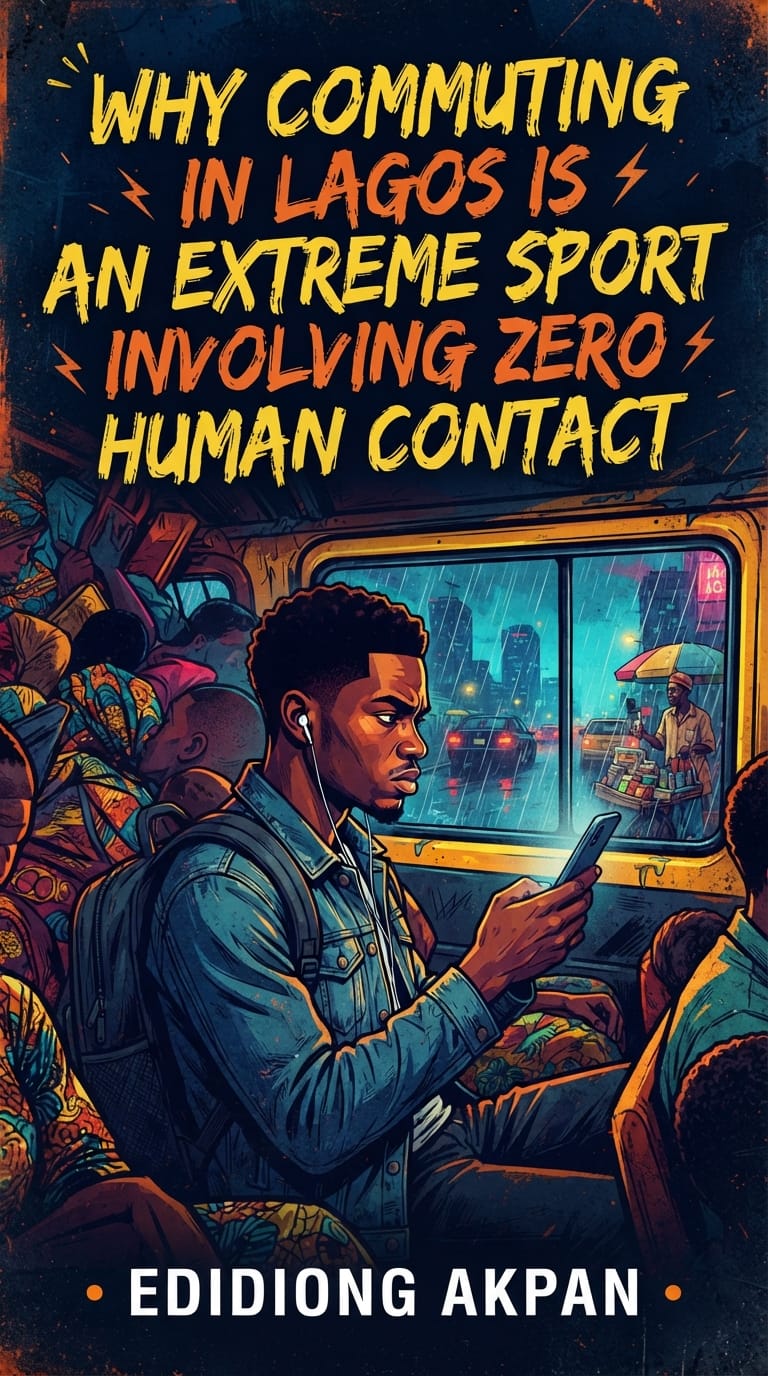
If you live in Lagos, you already know that commuting is not just a way to get from point A to point B.
It is an extreme sport, a psychological thriller, and a masterclass in survival all rolled into one. This is me not being overly dramatic.
Whether you are squeezing into a yellow danfo bus at Ojuelegba, trying to secure a spot on the BRT, or navigating the madness of rush hour traffic on the Third Mainland Bridge, you quickly learn that public transit comes with a heavily enforced, unspoken code of conduct.
What are these code? Buckle your seat belt and enjoy the ride.
The first and most sacred rule of Lagos public transportation is the absolute prohibition of accidental eye contact.
This is not just about being polite; it is a matter of national security for your peace of mind.
The moment you step into a vehicle, you must activate your peripheral vision to track moving objects while keeping your eyeballs locked firmly straight ahead or down at your shoes.
If your eyes accidentally graze against a fellow passenger's gaze, you have opened a portal. Suddenly, you are locked in a silent standoff, or worse, they take it as an invitation to start a full-blown conversation about the price of fuel, politics, or why you look so serious.
We are all tired, we are all trying to survive the heat, and locking eyes with a stranger at 7:30 AM is a rookie mistake you only make once.
To enforce this invisible barrier, you have to master the ultimate Lagos survival skill, which involves the "do not perceive me" resting face.
This facial expression requires a precise combination of stone-cold indifference, a slight frown, and the aura of someone who has survived three different landlords increasing rent in a single year.
You want to look entirely unapproachable. You want the conductor, the street hawkers selling gala and lacasera through the window, and the person sitting next to you to look at your face and collectively decide that you are definitely not the one to try today.
It is an art form.
If anyone dares to glance your way, your expression should communicate that disturbing your peace will result in immediate spiritual and physical consequences.
Of course, even the best resting face needs a prop, which brings us to the holy grail of transit etiquette: pretending your phone is the most fascinating, mind-blowing object on earth.
It does not even matter if you have service or data. You could literally be staring at your blank home screen, scrolling endlessly through your photo gallery looking at screenshots of memes you saved in 2023, or playing an offline game of solitaire for the four hundredth time.
The phone is your shield.
As long as your head is bowed and your thumb is swiping, you are officially invisible to the outside world. It sends a universal message to everyone around you that you are deep into urgent corporate business or watching a high-stakes video, when in reality, you are just hiding from human interaction.
Then, of course, you have to factor in the physical geometry of Lagos transport.
When a danfo conductor shouts "two lucky yansh!" and crams three people into a space built strictly for two, personal space ceases to exist.
Your shoulder is glued to a stranger, your bag is wedged between your knees, and someone's elbow is permanently resting near your ribs.
Yet, despite this extreme physical intimacy, the social distance remains infinite. Nobody speaks. Nobody complains out loud. We all just suffer in synchronised, sweaty silence, desperately holding onto our phones, avoiding eye contact at all costs, and praying the vehicle doesn't break down before we cross a bridge.
Living in Lagos means you quickly realise that your commute is a psychological battlefield.
But if you master the holy trinity of Lagos transit, which has to do with the blank stare, the unapproachable face, and the dead phone screen, you can glide through the chaos like a ghost.
Yes, Lagos public transport system is funny, it is exhausting, but honestly, we wouldn't survive it any other way.