Writers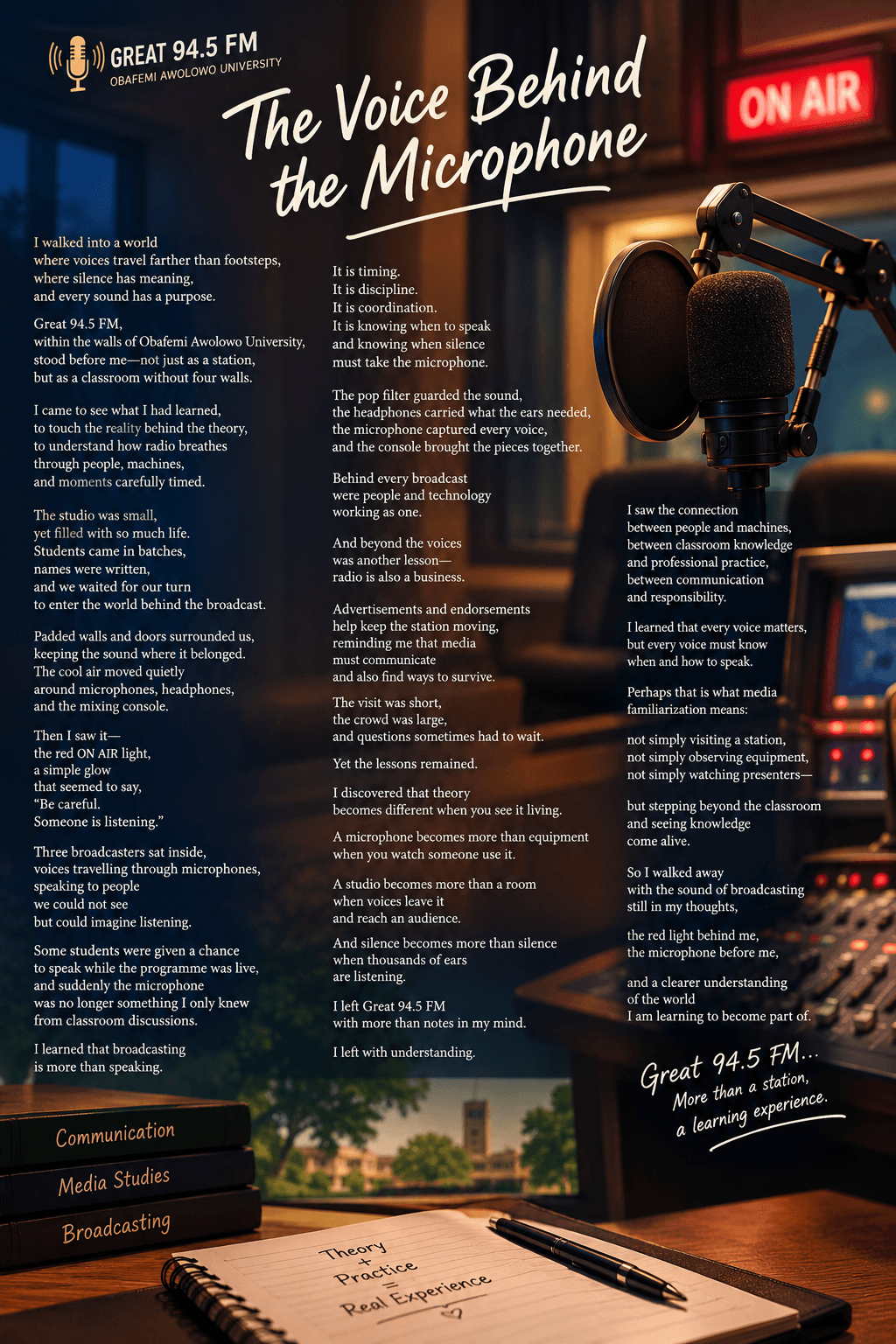
THE VOICE BEHIND THE MICROPHONE
I walked into a world
where voices travel farther than footsteps,
where silence has meaning,
and every sound has a purpose.
Great 94.5 FM,
within the walls of Obafemi Awolowo University,
stood before me not just as a station,
but as a classroom without four walls.
I came to see what I had learned,
to touch the reality behind the theory,
to understand how radio breathes
through people, machines,
and moments carefully timed.
The studio was small,
yet filled with so much life.
Students came in batches,
names were written,
and we waited for our turn
to enter the world behind the broadcast.
Padded walls and doors surrounded us,
keeping the sound where it belonged.
The cool air moved quietly
around microphones, headphones,
and the mixing console.
Then I saw it
the red ON AIR light,
a simple glow
that seemed to say,
“Be careful.
Someone is listening.”
Three broadcasters sat inside,
voices travelling through microphones,
speaking to people
we could not see
but could imagine listening.
Some students were given a chance
to speak while the programme was live,
and suddenly the microphone
was no longer something I only knew
from classroom discussions.
I learned that broadcasting
is more than speaking.
It is timing.
It is discipline.
It is coordination.
It is knowing when to speak
and knowing when silence
must take the microphone.
The pop filter guarded the sound,
the headphones carried what the ears needed,
the microphone captured every voice,
and the console brought the pieces together.
Behind every broadcast
were people and technology
working as one.
And beyond the voices
was another lesson
radio is also a business.
Advertisements and endorsements
help keep the station moving,
reminding me that media
must communicate
and also find ways to survive.
The visit was short,
the crowd was large,
and questions sometimes had to wait.
Yet the lessons remained.
I discovered that theory
becomes different when you see it living.
A microphone becomes more than equipment
when you watch someone use it.
A studio becomes more than a room
when voices leave it
and reach an audience.
And silence becomes more than silence
when thousands of ears
are listening.
I left Great 94.5 FM
with more than notes in my mind.
I left with understanding.
I saw the connection
between people and machines,
between classroom knowledge
and professional practice,
between communication
and responsibility.
I learned that every voice matters,
but every voice must know
when and how to speak.
Perhaps that is what media familiarization means:
not simply visiting a station,
not simply observing equipment,
not simply watching presenters
but stepping beyond the classroom
and seeing knowledge
come alive.
So I walked away
with the sound of broadcasting
still in my thoughts,
the red light behind me,
the microphone before me,
and a clearer understanding
of the world
I am learning to become part of.