Writers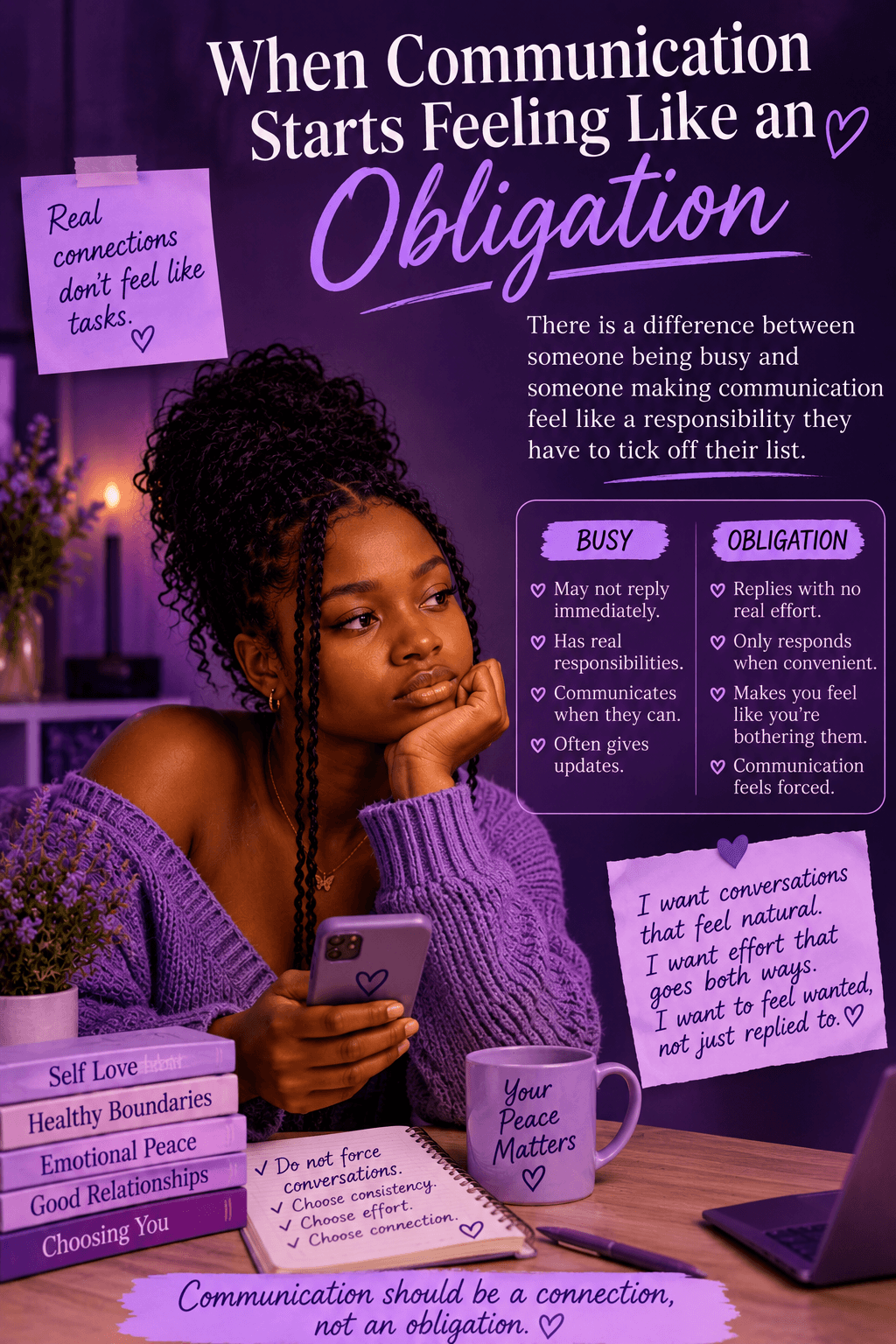
When Communication Starts Feeling Like an Obligation
There is a difference between someone being busy and someone making communication feel like a responsibility they have to tick off their list.
And sometimes, you can feel the difference.
I've experienced this myself.
There have been times when I've found myself being the one to always start the conversation, check in, ask how someone is doing, and try to keep things going.
At first, I didn't think much of it.
I would tell myself, "Maybe they're busy."
Then I'd think, "Maybe they're tired."
I'd make excuses because I didn't want to believe that the effort between us was no longer the same.
But after a while, you start noticing patterns.
The replies become shorter.
The conversations become harder to maintain.
You stop feeling excited to send a message because you're already wondering whether you'll get a dry response.
And eventually, communicating starts feeling like something you're doing because you don't want the connection to disappear—not because the conversation is naturally happening between two people.
That feeling can be painful.
Because technically, you're still communicating.
They still reply.
They still answer sometimes.
Nothing has officially ended.
But something feels different.
And sometimes, that's what hurts the most.
I remember asking myself, "Am I asking for too much?"
Maybe I'm expecting too much.
Maybe I'm disturbing them.
Maybe I should stop texting first.
Maybe if I stop making the effort, we'll stop talking completely.
And that last thought can really hurt.
Because you begin to wonder whether the connection would even exist if you stopped carrying it.
I've learned that I don't want to keep putting myself in that position.
I don't expect anyone to be available to me every minute of the day.
I understand that people have work, responsibilities, family, personal problems and days when they simply don't feel like talking.
I have those days too.
But there is a difference between being busy and consistently making someone feel like communicating with them is a burden.
I value effort.
I value someone who can say, "I'm busy right now, but I'll get back to you."
Someone who remembers to check in.
Someone who asks about my day because they genuinely want to know.
Someone who doesn't make me feel like I'm forcing my way into their life.
And I've also learned something about myself.
I shouldn't have to keep overextending myself just to maintain a connection.
I've done that before.
I've kept conversations alive when they were clearly becoming one-sided.
I've made myself available because I didn't want someone to think I didn't care.
But eventually, it becomes exhausting.
You start giving more than you're receiving, and instead of feeling connected, you feel drained.
That's when I realized that communication isn't only about sending messages.
It's about mutual effort.
It's about wanting to hear from each other.
It's about being considerate.
It's about knowing that even when life gets busy, the other person isn't constantly left wondering where they stand.
I'm learning to stop forcing conversations.
Not because I'm trying to punish anyone.
Not because I want to play games.
But because sometimes you need to step back and see what happens when you stop doing all the work.
Will they notice?
Will they reach out?
Will they ask where you've been?
Or will everything simply go quiet?
Sometimes, that silence tells you something.
And I've learned not to be afraid of the answer.
Because I would rather accept that a connection has changed than keep pretending everything is the same.
I don't want communication that feels like an obligation.
I don't want someone talking to me because they feel guilty for not replying.
And I don't want to make anyone feel that way about me either.
I want conversations that feel natural.
I want effort that goes both ways.
I want to feel like the person I'm talking to actually wants to hear from me.
Because there is a difference between being replied to and being wanted in a conversation.
And I'm learning to choose the latter.
Sometimes, stepping back isn't giving up.
Sometimes, it's simply giving the other person room to show you whether they were ever walking beside you—or whether you were the one doing all the walking.