Writers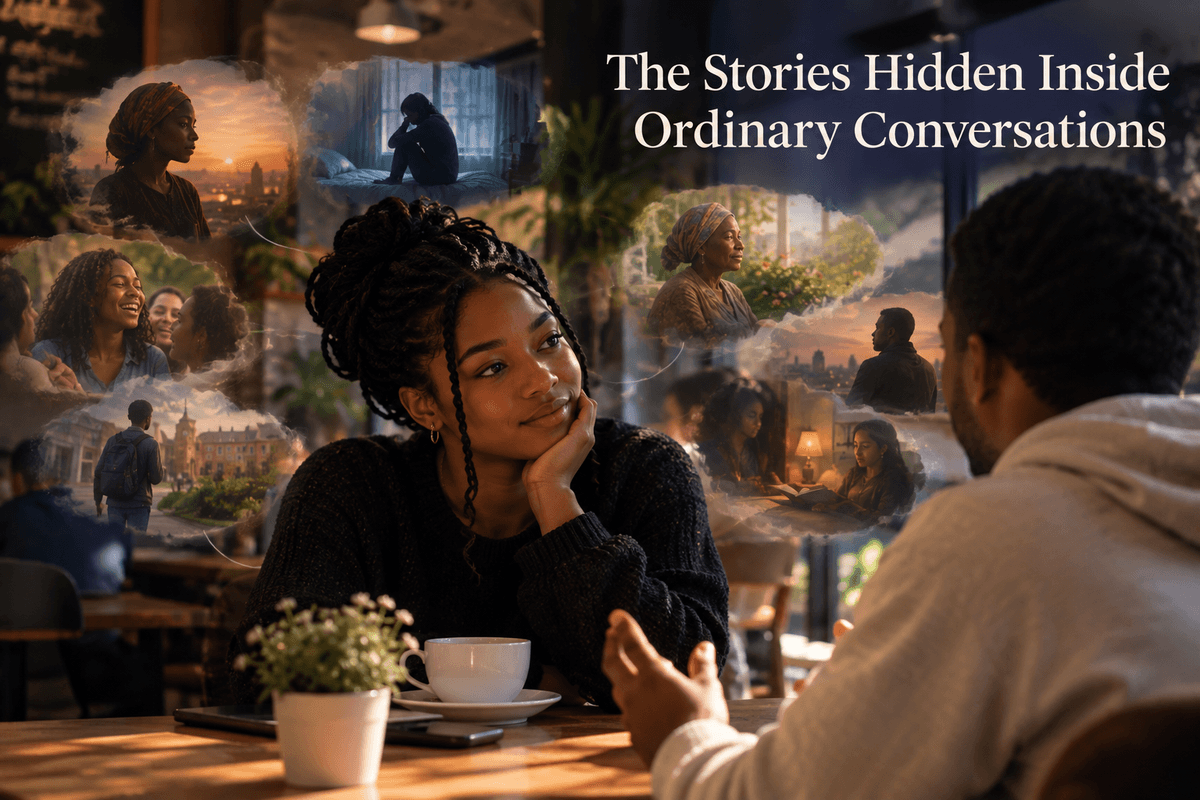
There is something beautiful about ordinary conversations. They often begin with nothing: How was your day? Have you eaten? Are you going home? Yet beneath these simple questions, there are stories waiting to be heard.
People rarely tell us everything at once. Sometimes, a person says, “I’m tired,” when what they mean is, “I have been carrying too much.” Someone says, “I’m fine,” because explaining the truth feels heavier than hiding it. A mother asks whether you have eaten, not because she is interested in food, but because care has become the language she knows.
A conversation at a bus stop, in a classroom, beside a shop, or across a kitchen table can hold more than its words suggest. A stranger complains about the rain, but perhaps they are remembering a day they wished had never ended. A friend laughs about something small, while quietly hoping someone will notice that they are not really laughing.
Sometimes, what matters most is not what someone says, but what slips through between the words. The pause before an answer. The sudden change in tone. The sentence repeated twice. The joke that arrives too quickly. The silence that follows a question.
If we listen closely, people reveal themselves in fragments. Even silence can speak a language.
An elderly woman talking about her garden may really be talking about the husband she lost. A student complaining about school may be carrying fears about the future. A young woman saying she wants to be independent may be speaking from years of being told what she should become.
We often think stories need extraordinary events to be meaningful. But most lives are not made of dramatic scenes. They are made of mornings, errands, arguments, laughter, disappointments, meals, journeys, and conversations that seem forgettable until memory gives them meaning.
Years later, we may remember a sentence someone said without realizing it would stay.
Maybe that is why ordinary conversations deserve our attention. They are windows into lives we can never fully know. Every person we meet carries a private world: memories we cannot see, wounds they rarely mention, dreams they may be afraid to speak aloud.
It means allowing someone to be more than the role they occupy in our lives. The cashier is not only a cashier. The neighbour is not only the neighbour. The friend who sends a casual message may be fighting a battle they have not found words for.
And sometimes, we are the ones hiding stories inside ordinary conversations.
We say, “I’ll be okay,” while hoping someone will stay. We say, “It doesn’t matter,” when it matters deeply. We talk about ordinary things because ordinary things are easier to hold than the truths beneath them.
Some open only a little. Some remain closed. Others invite us into rooms filled with memories, fears, dreams, and tenderness.
We may never know the whole story.
But if we listen carefully, we might hear enough to understand that even the simplest words can carry an entire life.