 Writers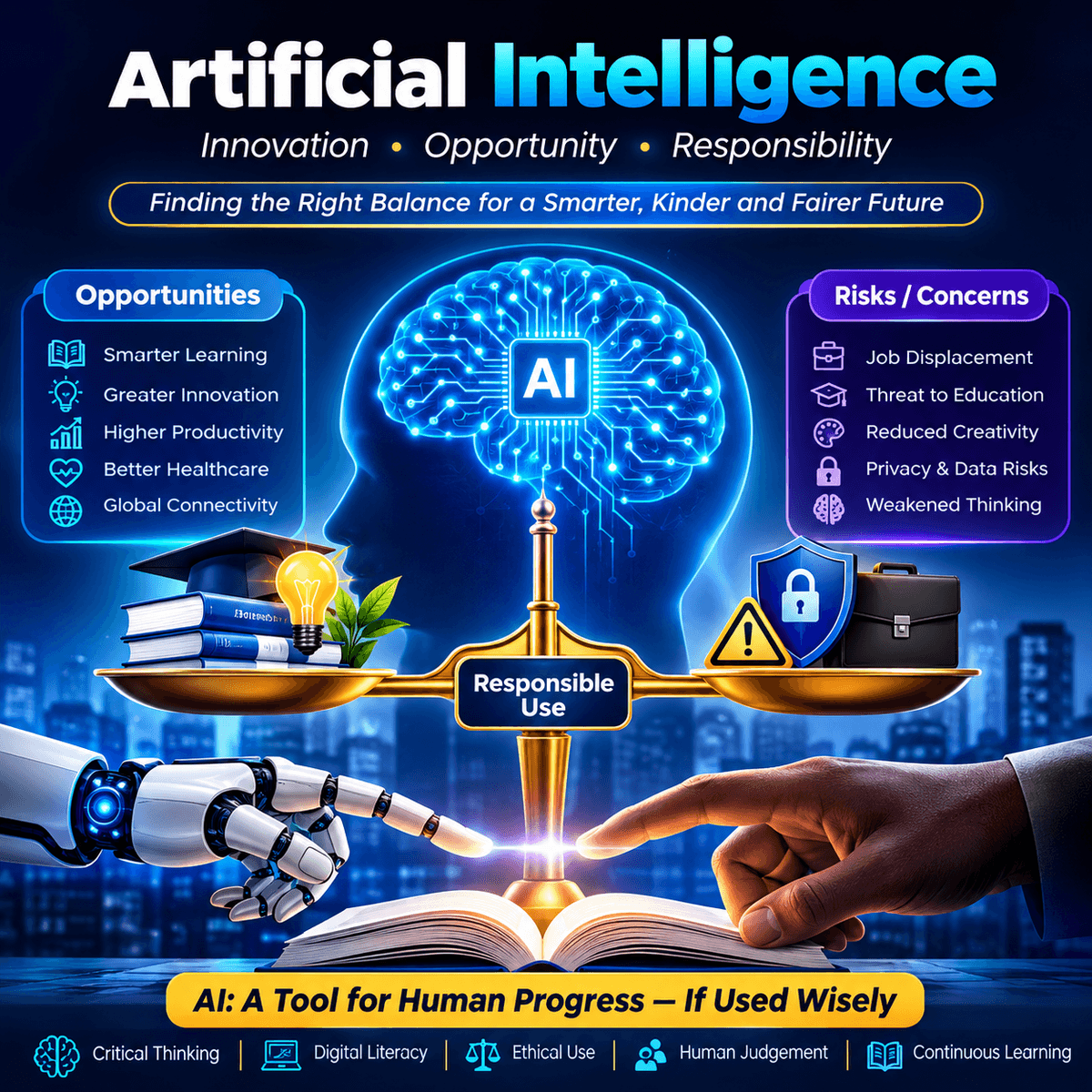
Artificial intelligence (AI) has moved rapidly from the pages of science fiction into the regular routines of daily life. Students, teachers, business owners, researchers, writers, designers, professionals, and families can now access what was previously only available to scientists, engineers, and techies. Artificial intelligence can help you with research, translate languages, generate images, organize data, summarize long materials, brainstorm, analyze information, and automate repetitive tasks with a single command. Its increasing power has created remarkable possibilities but has also raised serious questions about how far society should allow technology to guide human endeavors.
As a result, there have been conflicting responses to the increasing use of AI. Some consider it to be one of the most significant technological developments of the modern era, increasing productivity and resolving issues that previously required a significant investment of time and resources. Others take a cautious approach, worried about how it might affect employment, education, creativity, privacy, relationships, ps, ps, and independent thought. Neither viewpoint should be disregarded. We shouldn't fear AI unreasonably, nor should we accept it without question. Society must have a careful awareness of its potential and constraints.
Employment is one of the most important topics of discussion regarding AI. It makes sense that some employees worry that jobs that have historically been performed by humans will eventually be replaced by machines. AI can be used by businesses to automate repetitive tasks like information processing, document analysis, report generation, and customer service. This is a serious issue, particularly as technology advances more quickly than employees can pick up new skills.
However, rather than completely eliminating nature's work, technological advancements have frequently altered it. For example, the introduction of computers changed many jobs, but it did not make people obsolete. AI has the potential to eliminate certain repetitive tasks and generate the duties difficulty lies in preparing people for this shift via education, leisure, activity, and lifelong learning.
Another significant area of contention is education. AI can help students understand challenging ideas, practice questions, improve their grammar, and receive individualized help. When utilized appropriately, these options can enhance education. When a student lets AI do all of the thinking, there is a risk. The immediate assignment may be finished, but the educational goal has been undermined if a student turns in AI-generated work without comprehending the subject.
Therefore, the distinction goes beyond simply "using AI" versus "not using AI." The distinction between using AI as a learning aid and using AI to replace learning is more important. After asking AI to explain a concept, a student can study that explanation. It can be used by a writer to generate ideas, which they can then refine using their own judgment and research. In these situations, technology enhances human intelligence rather than takes its place.
The topic of creativity has also been discussed. Writers, graphic designers, photographers, rappers, and other creative professionals are curious about the content that generated artistic identity, originality, and originality. Artificial intelligence has the potential to produce incredible things, but creativity is more than just a good outcome. Personal experiences, emotions, culture, relationships, relationships, relationships, and obs are all sources of human creativity. These facets of human experience provide meaning and context for artistic endeavors and searching for artistic work.
That doesn’t mean AI has no role in creative work. It can serve as a brainstorming partner, an editing assistant, a design aid, or a tool for experimentation. The responsibility lies in ensuring that the human creator remains involved in the process and takes responsibility for the final product.
Accuracy and privacy must also be given careful consideration. Large volumes of data can be processed by artificial intelligence systems. Users occasionally share sensitive information without considering the consequences. As a result, people should be more cautious about the data they give AI platforms. Entering personal, academic, academic, academic, academic, or organizational data into any system without understanding how it might be handled is not a good idea.
Precision is another issue. Artificial intelligence can produce answers that seem plausible but are either outdated, inaccurate, or incompetent. An AI-generated response's confidence should not be interpreted as its veracity. This is particularly true in professions where false information can have major repercussions, such as medicine, law, finance, scientific research, and academic work. A human check will still be required.
In the end, the discussion about AI must go beyond whether the technology is beneficial or detrimental. Human morality is not the same in technology as it is in humans. Regulation, deregulation, employment, regulation, and use all have a significant impact. A hammer has the power to harm someone or construct a house. The intention of the user is not determined by the tool itself. AI must also be guided responsibly by humans.
The goal should not be to reject AI just because it is powerful. The convenience of AI should not be at the expense of society giving away human judgment. The real challenge is the balance.
Embracing AI's efficiency without becoming dependent on it. We should be grateful for its ability to generate ideas without losing our own creativity. We should allow it to help education, but not replace genuine learning. We should automate the right things, but never forget the value and dignity of human contribution. Most importantly, we need to realize that intelligence is more than just producing information. Wisdom is the knowledge of how to use information, knowledge of the consequences, knowledge of how to judge, and taking responsibility for our decisions.
AI must be a tool in the hands of humans, not a substitute for human responsibility. The future won’t necessarily belong to those who use the most AI but to those who know how to use it wisely.
We will have to deal with artificial intelligence in our daily lives. It already does. Whether humans will be more adept at using AI or just reliant on it is the more important question. The decisions we make today will provide the solution.
Balance does not mean rejecting progress. It means embracing progress without losing ourselves in it. It means allowing technology to extend our abilities while preserving the critical thinking, creativity, compassion, integrity, and responsibility that make human beings unique. If AI is guided by these principles, it can become more than a source of convenience. It can become a powerful instrument for learning, innovation, productivity, and human development—without becoming the master of the people it was created to serve.