 Writers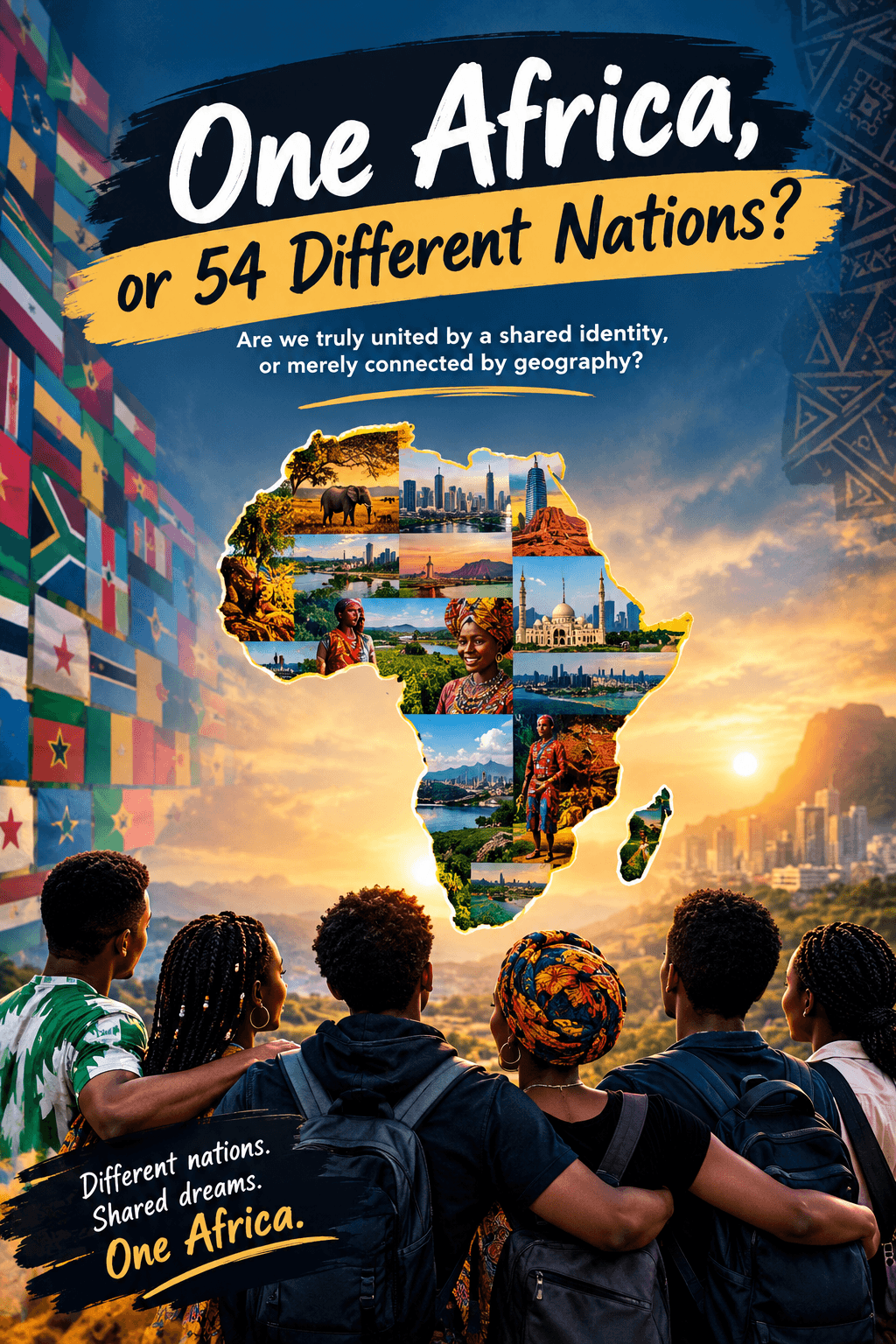
Draw a line across a map, and you create a border. But can you draw a line across a people and create a separation?
Africa has 54 internationally recognised countries, each with its own flag, government, history and national identity. Yet beyond those political boundaries lies a continent connected by stories that no border can completely contain. Our differences are undeniable. So are our connections.
The question, then, is not simply whether Africa is one continent or 54 nations. The deeper question is this: when our borders divide us, what still gives us the right to say, “We are Africans”?
Perhaps the answer is that we are both.
Africa is not a single culture. It is a continent of extraordinary diversity. From the markets of Lagos to the streets of Nairobi, from the Sahel to the southern coast, African societies have developed different traditions, languages, religions, political systems and ways of life. A Nigerian cannot simply speak for a Kenyan, just as a Ghanaian cannot represent the experiences of a South African. Recognising African unity should never require us to erase these differences.
Yet diversity does not necessarily mean division.
Across our borders, there are experiences that connect us. We share histories shaped by colonialism, struggles for independence, cultural exchanges, economic challenges and the determination to build better futures. Our music crosses borders. Our films tell stories that audiences recognise far beyond their countries of origin. African athletes compete under different flags but often inspire an entire continent. Young Africans communicate through technology without allowing national borders to determine who they can learn from, collaborate with or admire.
Even our languages reveal our interconnectedness. A single African city can contain several languages and cultures living side by side. Our diversity is not evidence that Africa lacks an identity. It may actually be one of the most important features of that identity.
But unity remains unfinished.
National interests can sometimes become stronger than continental interests. Political disagreements, ethnic tensions, economic inequality, insecurity, poor infrastructure and distrust between institutions can make cooperation difficult. Colonial borders, drawn without sufficient regard for existing communities and identities, left complicated legacies that many African countries still navigate today.
There is also a more personal division: the way Africans sometimes see one another.
Stereotypes can travel as easily as music. We may know very little about another African country yet form opinions about its people. When ignorance replaces curiosity, neighbours become strangers.
This is why African unity cannot simply be declared at political meetings. It must be built in everyday life.
It begins when a student in Nigeria becomes curious about a student in Rwanda rather than assuming they have nothing in common. It grows when entrepreneurs collaborate across borders, when artists share their cultures, when researchers solve problems together, and when young people recognise that another African nation's progress does not threaten their own.
True unity does not demand sameness.
Europe has its differences. Asia has its differences. The Americas have their differences. Diversity is not the opposite of unity; intolerance is.
For me, being African is therefore not about pretending that our 54 nations are one nation. It is about understanding that our national identities can exist alongside a broader continental identity.
I am Nigerian. Someone else may be Senegalese, Ethiopian, Tanzanian or Egyptian. Those identities matter. But they do not have to prevent us from saying, “We are Africans.”
Africa does not need to become one country before Africans can become more united.
The real question is not whether Africa is one nation or 54 nations.
It is whether 54 nations can choose to build a future together.
Our borders may tell us where one country ends and another begins. They do not have to determine where our solidarity ends.
Africa is 54 nations. But perhaps our greatest strength lies in learning how to become one continent without losing the many voices that make it extraordinary.