 Writers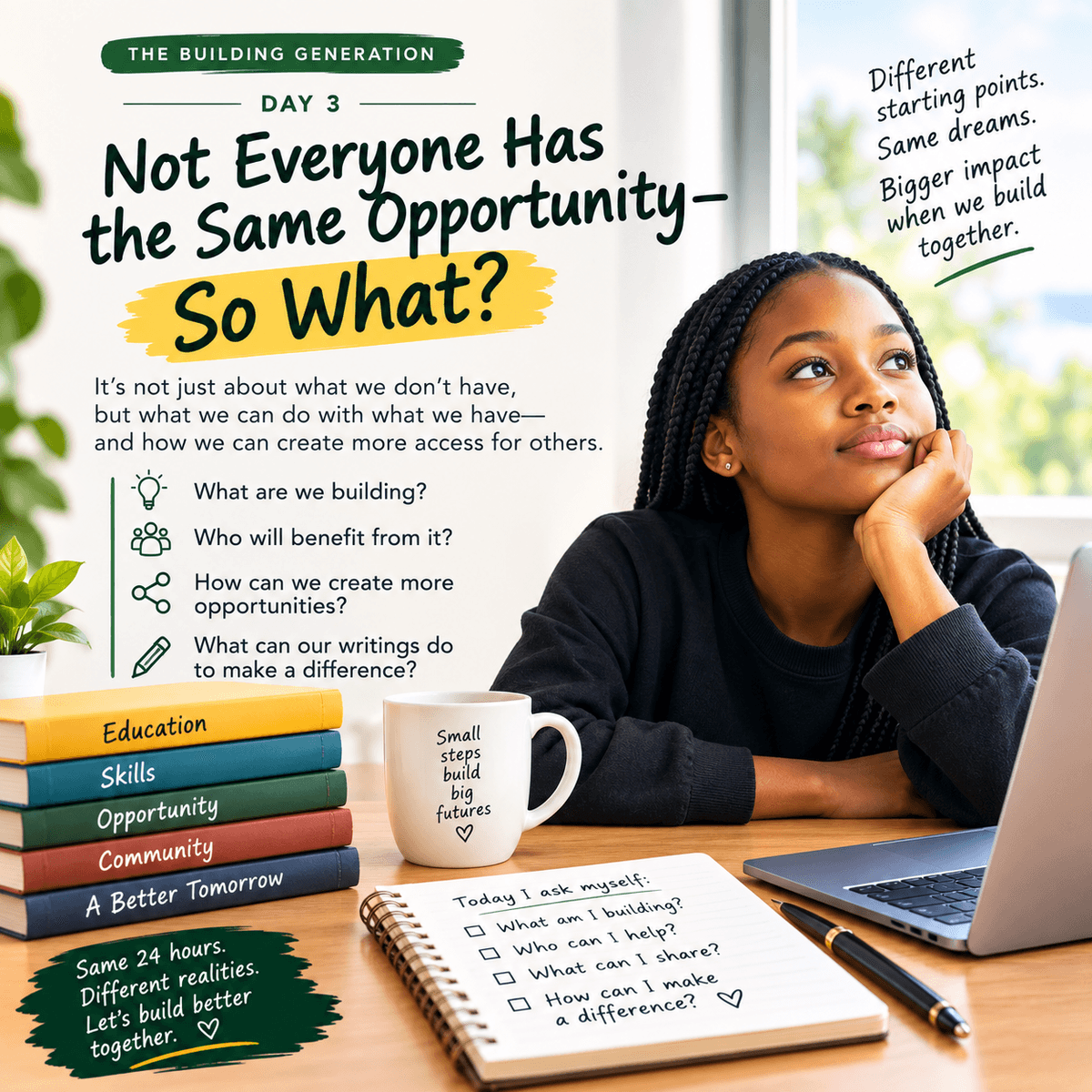
THE BUILDING GENERATION — DAY 3
Not Everyone Has the Same Opportunity So What?
Yesterday, we asked a simple but uncomfortable question:
What are you building?
Today, I want to ask an even harder one.
What do you do when you realise that the person beside you was given a different starting point?
Because we need to stop pretending that everybody is running the same race.
We are not.
Two young people can be born in the same year, attend the same school and even sit in the same classroom, yet go home to completely different realities.
One has parents who can pay for extra lessons, buy a laptop and fund a professional course.
Another is wondering whether there will be food at home that evening.
One has someone who can say, “I know somebody who can help you get this opportunity.”
Another has never had that kind of connection.
One has uninterrupted internet.
Another depends on whenever they can afford data.
One can afford to make mistakes while learning.
Another mistake could mean losing the little money they have.
One is encouraged to dream.
Another is told to be realistic before they have even had the chance to discover what they can do.
That difference is real.
Recent youth consultations in Nigeria have highlighted barriers involving location, disability, gender, social exclusion and unequal access to services. UNICEF also reports that young people are asking for stronger pathways connecting skills to actual jobs, livelihoods, mentorship, finance, technology and networks.
So when someone says,
“Everybody has the same 24 hours,”
I understand the point.
Time matters.
Discipline matters.
Personal responsibility matters.
But let's be careful.
Twenty-four hours is a measurement of time. It is not a measurement of opportunity.
And recognising that difference should not make us bitter.
It should make us wiser.
Because there are two dangerous responses to inequality.
The first is to pretend it doesn't exist.
We look at someone struggling and immediately say:
“They are lazy.”
“They don't want it badly enough.”
“I did it, so they can do it too.”
But your experience is not automatically somebody else's experience.
Your road is not their road.
The second dangerous response is the opposite:
“Since life isn't fair, there is no point trying.”
That can become its own prison.
Yes, some doors are harder for certain people to reach.
Yes, some systems are unfair.
Yes, some people receive opportunities they did not necessarily work for.
But the question remains:
What can we do from where we are?
And perhaps even more importantly:
How can we make the road less difficult for the person coming behind us?
That is where I think our generation needs a different mindset.
Don't only ask:
“How do I get out?”
Ask:
“Who can I help come out with me?”
If you learn something, teach someone.
If you discover an opportunity, share it.
If you have information that could change someone's direction, don't keep it simply because you found it first.
If you have a platform, use it responsibly.
If you have a network, introduce people where appropriate.
If you have resources, create room.
If you have already crossed a bridge, don't destroy the bridge behind you.
Because sometimes the greatest thing you can build isn't something with your name on it.
Sometimes it is access.
A young person who couldn't afford a course may need someone to teach them for free.
A student who doesn't know where to find opportunities may simply need someone to say, “Have you heard about this?”
Someone may not need your money.
They may need your knowledge.
Someone may not need you to solve their entire life.
They may need one introduction.
One recommendation.
One honest conversation.
One opportunity to be seen.
This matters because there are already examples of programmes in Nigeria trying to close some of these gaps. UNICEF reports that its Digital Learning and Skills Empowerment Project has provided digital literacy, vocational training, entrepreneurship and life-skills support to vulnerable children and young people in northern Nigeria, including in Kano, Kaduna, Jigawa, Katsina and Sokoto.
The point isn't that one programme can solve everything.
It can't.
The point is that access changes what becomes possible.
And that should challenge those of us who have access to ask a different question.
What are we doing with ours?
Because access comes with responsibility too.
If you have been given an education, what are you doing with the knowledge?
If you have a smartphone and internet access, what are you using them to learn?
If you have a voice, what are you using it to say?
If you can write, what are you putting into people's minds?
And this is where I want to speak directly to us as writers.
We cannot write endlessly about young people needing to do better while ignoring the realities many young people face.
We should not romanticise struggle.
We should not shame poverty.
We should not turn every difficult circumstance into a motivational quote.
Sometimes people don't need to hear, “Work harder.”
Sometimes they need to hear:
“Here is where you can learn.”
“Here is the opportunity.”
“Here is what I discovered.”
“Here is how you can start.”
“You don't have to figure this out alone.”
That is a different kind of writing.
Writing that doesn't only inspire.
Writing that equips.
Imagine if more young writers began creating content that connected people to scholarships, skills, books, legitimate opportunities, mentorship, entrepreneurship resources, community projects and practical knowledge.
Imagine if our pages became places where young people didn't just feel motivated for five minutes but actually discovered something they could use.
That is the kind of building I want us to think about.
Not everyone has the same opportunity.
So what?
So we acknowledge it.
We stop judging people's journeys from the comfort of our own.
We take responsibility for what is within our reach.
And where we have access, we create more access.
Maybe we cannot fix every broken system.
Maybe we cannot give everyone the same starting point.
But we can refuse to make the journey unnecessarily harder for somebody else.
And perhaps that is one way a generation begins to change a society:
Not by pretending the inequality doesn't exist.
Not by giving up because it exists.
But by looking at what we have and asking:
“Who can I help with this?”
“What can I make easier?”
“What can I share?”
“What can I build that outlives me?”
Because one day, somebody may stand where we are standing now.
And I hope they find that we didn't only complain about how difficult the road was.
I hope they find a road we helped make a little better.
Today's question isn't:
“Why doesn't everyone have what I have?”
It is:
“Since I have what I have, what am I going to do with it and who can benefit from it?”
