Writers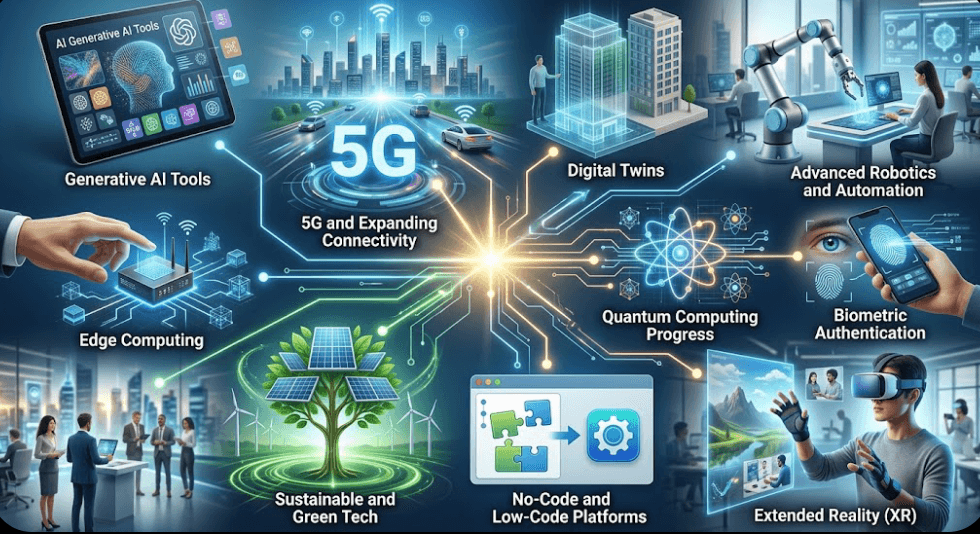
Technology moves fast, and it's easy to feel like you're always one step behind. New tools, platforms, and breakthroughs appear every month, each promising to change how we work, communicate, or live. But not every innovation deserves your attention — and sorting the meaningful from the hype can feel like a full-time job.
That's where this guide comes in. Below are ten technologies currently reshaping industries and everyday life. Whether you're a business owner, a curious professional, or simply someone who wants to stay informed, understanding these innovations will help you make smarter decisions about the tools you adopt and the trends you follow.
1. Generative AI Tools
Generative AI has moved far beyond chatbots. Businesses now use it to draft marketing copy, summarize reports, write code, and generate images or video from simple text prompts. For small businesses especially, this means tasks that once required specialized staff — like basic graphic design or first-draft content — can now be handled faster and more affordably.
The practical takeaway: if your work involves repetitive writing, research, or design tasks, exploring generative AI tools could meaningfully reduce the time you spend on them.
2. Edge Computing
Traditional cloud computing sends data to centralized servers for processing. Edge computing flips this by processing data closer to where it's generated — on local devices or nearby servers. This reduces delay, which matters for applications like autonomous vehicles, industrial sensors, and real-time video analysis.
For businesses relying on connected devices, edge computing often means faster response times and reduced bandwidth costs, since not every piece of data needs to travel to a distant data center.
3. 5G and Expanding Connectivity
5G networks offer significantly faster data speeds and lower latency than their predecessors. This isn't just about faster phone downloads it enables real-time applications like remote surgery assistance, smart factory equipment, and augmented reality experiences that simply weren't practical on older networks.
As 5G coverage continues to expand, industries that depend on instant data transfer stand to benefit the most.
4. Advanced Robotics and Automation
Robotics has moved well beyond factory assembly lines. Modern robots now assist in warehouses, hospitals, and even restaurants, handling tasks ranging from inventory sorting to meal preparation. Collaborative robots, or "cobots," are designed to work alongside human employees rather than replace them entirely, often handling repetitive or physically demanding tasks.
For business owners, automation can reduce errors and free up staff for higher-value work — though it requires upfront investment and thoughtful implementation.
5. Digital Twins
A digital twin is a virtual replica of a physical object, system, or process. Manufacturers use digital twins to simulate how a product will perform before building it, while city planners use them to model traffic patterns or infrastructure projects.
This technology allows for testing and troubleshooting in a virtual environment, which can catch costly problems before they happen in the real world.
6. Quantum Computing Progress
Quantum computing is still in its early stages, but progress is accelerating. Unlike traditional computers that process information in binary, quantum computers use quantum bits, allowing them to handle certain complex calculations like drug discovery simulations or advanced cryptography far more efficiently.
While quantum computing isn't yet practical for everyday business use, it's worth watching, as breakthroughs here could eventually transform fields like medicine, finance, and logistics.
7. Biometric Authentication
Passwords are increasingly being supplemented or replaced by biometric authentication — fingerprint scans, facial recognition, and even voice verification. This shift is driven by both convenience and security, as biometric data is harder to steal or replicate than a traditional password.
Many smartphones and workplace security systems already rely on this technology, and its use is expanding into banking, healthcare, and travel.
8. Sustainable and Green Tech
Innovation isn't only about speed and automation — it's also about sustainability. Advances in battery storage, solar efficiency, and carbon capture technology are helping industries reduce environmental impact without sacrificing performance.
Businesses adopting green tech often find additional benefits beyond environmental responsibility, including long-term cost savings on energy and improved brand reputation among environmentally conscious consumers.
9. No-Code and Low-Code Platforms
Building software used to require specialized programming knowledge. No-code and low-code platforms are changing that, allowing people with little to no coding background to build websites, apps, and automated workflows using visual, drag-and-drop interfaces.
This democratization of software development means small businesses and individual entrepreneurs can create custom digital tools without hiring a full development team — saving both time and money.
10. Extended Reality (XR)
Extended reality is an umbrella term covering virtual reality (VR), augmented reality (AR), and mixed reality (MR). While gaming remains a popular use case, XR is increasingly used for employee training, virtual product demonstrations, and remote collaboration.
For example, some companies use VR simulations to train employees for high-risk scenarios — like equipment repair or emergency response — in a safe, controlled environment.
Staying Ahead Without Getting Overwhelmed
You don't need to adopt every new technology the moment it appears. The smarter approach is understanding which innovations align with your specific needs — whether that's improving efficiency, cutting costs, enhancing security, or simply staying competitive in your industry.
Start by identifying one or two areas where your business or daily routine could benefit most, then research practical, proven applications of the relevant technology. Innovation works best when it solves a real problem, not when it's adopted simply because it's trending.
As these ten technologies continue to mature, staying informed — without feeling pressured to chase every new development — will put you in a strong position to make confident, well-timed decisions about what to adopt next.