Writers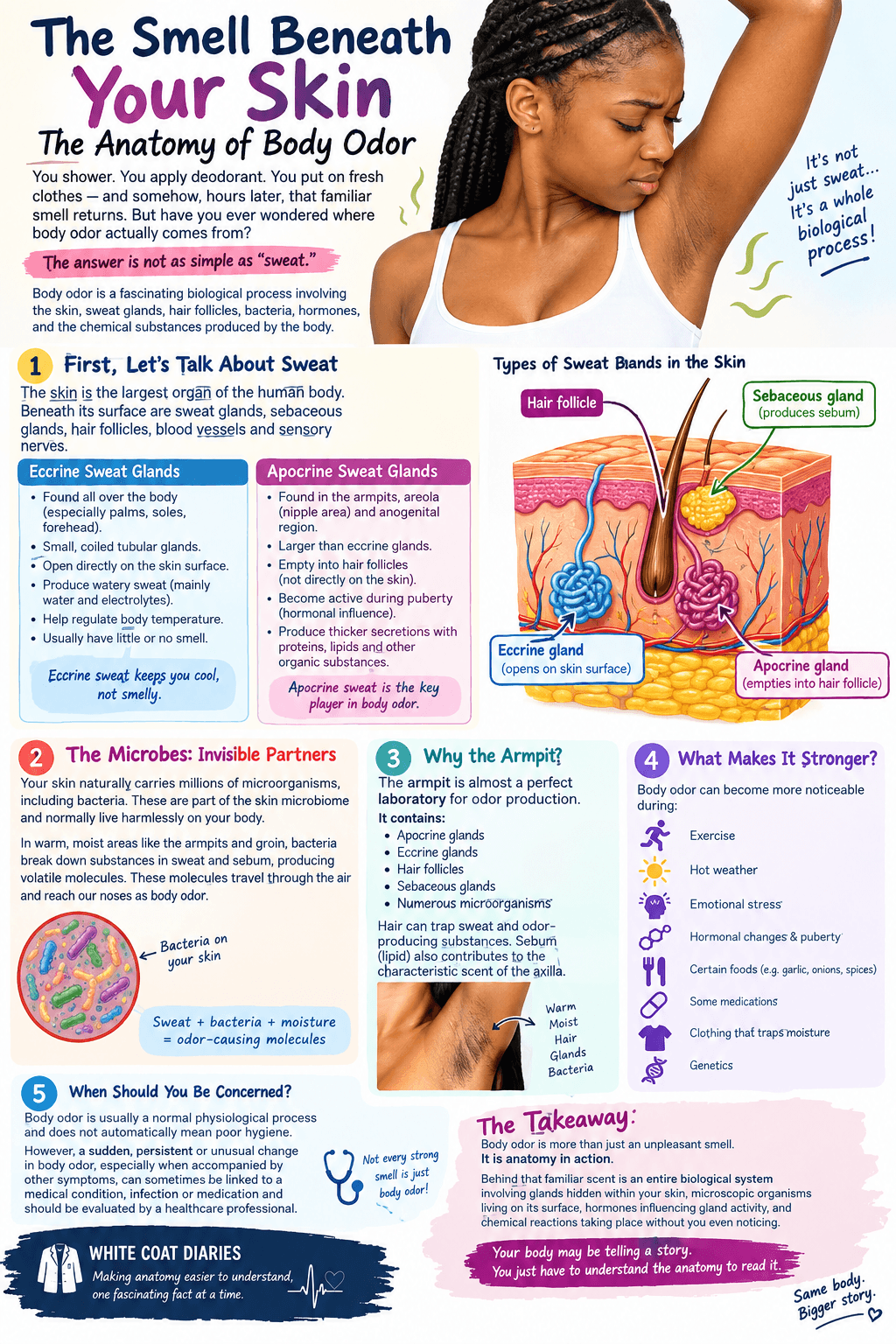
The anatomy behind body odor
You shower. You apply deodorant. You put on fresh clothes—and somehow, hours later, that familiar smell returns. But have you ever wondered where body odor actually comes from?
The answer is not as simple as “sweat.”
Body odor is a fascinating biological process involving the skin, sweat glands, hair follicles, bacteria, hormones, and the chemical substances produced by the body. What we perceive as an unpleasant smell is largely created when microorganisms on the skin break down substances released by certain glands.
💧 FIRST, LET'S TALK ABOUT SWEAT
The skin is the largest organ of the human body. Beneath its surface are numerous structures, including sweat glands, sebaceous glands, hair follicles, blood vessels, and sensory nerves.
There are two major types of sweat glands: eccrine glands and apocrine glands.
Eccrine sweat glands are distributed across most of the body, particularly on the palms, soles, and forehead. They are small, coiled tubular glands located deep within the skin. Their ducts open directly onto the skin surface.
Their primary function is thermoregulation. When your body becomes hot, eccrine glands produce sweat. As the sweat evaporates from the skin, it removes heat and helps cool the body.
Interestingly, eccrine sweat is mostly water and electrolytes and is generally not responsible for the strong smell we associate with body odor.
🦠 THEN WHO CREATES THE SMELL?
Meet the microscopic residents of your skin.
The skin naturally contains millions of microorganisms, including bacteria. These microorganisms form part of the skin microbiome and normally live harmlessly on the body.
However, some areas of the body provide particularly favorable conditions for bacterial activity. The armpits and groin, for example, are warm, moist, and rich in secretions from specialized glands.
When bacteria break down certain components of glandular secretions, they produce volatile molecules. These molecules travel through the air and reach our noses as what we recognize as body odor.
🔬 THE APOCRINE GLANDS
This brings us to one of the most important structures in the story: the apocrine sweat glands.
Apocrine glands are concentrated mainly in the axilla (armpit), areola around the nipple, and anogenital region. They are larger than eccrine glands and are closely associated with hair follicles.
Unlike eccrine glands, their ducts usually empty into hair follicles.
Apocrine glands become significantly active during puberty, when hormonal changes stimulate their development and function. Their secretions contain proteins, lipids, and other organic substances.
These secretions are initially not strongly odorous. The characteristic smell develops when skin microorganisms metabolize components of the secretion.
In simple terms:
Apocrine secretion + bacteria + moisture + time = body odor.
🧑🦱 WHY THE ARMPIT?
The armpit is almost a perfect laboratory for odor production.
It contains apocrine glands, eccrine glands, hair follicles, sebaceous glands, and numerous microorganisms. It is also naturally warm and often moist.
Hair can trap sweat and odor-producing substances close to the skin. Sebaceous glands release sebum, an oily substance that lubricates the skin and hair. Together, these factors can contribute to the characteristic odor of the axilla.
🌡️ WHY DOES IT GET WORSE?
Body odor can become stronger during exercise, hot weather, emotional stress, puberty, and hormonal changes. Diet, some medications, clothing, and individual genetic differences can also influence the smell.
Emotional stress is particularly interesting because it can increase sweating, including activity in areas where apocrine glands are abundant.
🩺 WHEN SHOULD YOU BE CONCERNED?
Body odor is usually a normal physiological process and does not automatically indicate poor hygiene. However, a sudden, persistent, or unusual change in body odor, particularly when accompanied by other symptoms, may sometimes be associated with a medical condition, infection, or medication and should be evaluated appropriately.
So, the next time you notice body odor, remember that it is more than just an unpleasant smell.
It is anatomy in action.
Behind that familiar scent is an entire biological system involving glands hidden within your skin, microscopic organisms living on its surface, hormones influencing gland activity, and chemical reactions taking place without you even noticing.
Your body may be telling a story. You just have to understand the anatomy to read it.
🥼 WHITE COAT DIARIES
Making anatomy easier to understand, one fascinating fact at a time.