Writers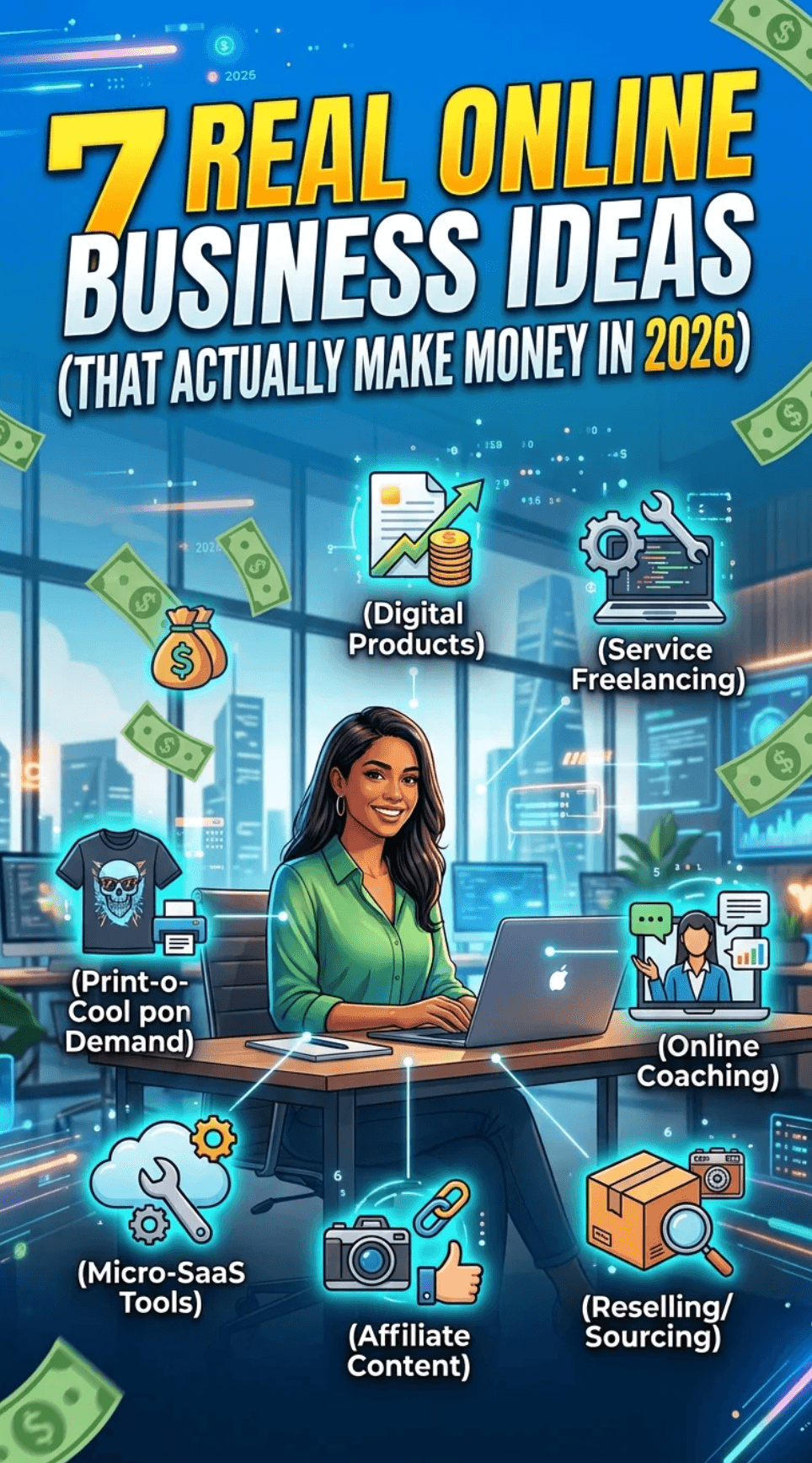
Most "online business ideas" articles read the same way: a list of vague suggestions like "start a blog" or "sell on Etsy," with no real detail on how anyone earns money from them. That's not very helpful if you're trying to figure out what to actually do this year.
This article covers seven online business models people are running right now, with real ways they bring in income. None of them are quick wins. Most take a few months of steady work before they pay off. But each one has a clear path from idea to actual money, which is more than you can say for a lot of business advice out there.
## 1. Niche Digital Products
Digital products like templates, spreadsheets, guides, presets, or small tools sell well because they cost nothing to reproduce. Once you've made the thing, every sale after the first is close to pure profit.
The businesses that work aren't the ones selling "100 Instagram Captions" to a general audience. They're the ones solving one clear problem for one clear group of people. A wedding planner who builds a client-intake spreadsheet and sells it to other wedding planners. A former nurse who creates shift-scheduling templates for hospital staff. A photographer who sells editing presets tuned for a particular style of portrait work.
The pattern here is simple: you already know something useful from your job or a hobby, and other people in that world would pay to skip the work of figuring it out themselves. Platforms like Gumroad, Payhip, or a basic Shopify store handle the payment and delivery side, so the main job is making something genuinely useful and finding the people who need it.
## 2. Service based freelancing with a speciality
General freelancing ("I can write anything" or "I do any kind of design") is a hard way to make money because you're competing with thousands of other generalists on price. Freelancers who pick one focus tend to do better, because there's less competition and clients pay more for someone who clearly knows their exact area.
A few examples: a copywriter who only writes email sequences for SaaS companies. A developer who only builds Shopify app integrations. A video editor who only turns long podcast episodes into short social clips. Each of these people can charge more than a generalist, because a client with that exact need doesn't have to explain the basics or worry about quality.
Getting work usually comes from a mix of direct outreach, emailing potential clients and platforms like Upwork or Contra to land the first few reviews. After that, referrals tend to bring in most of the work.
## 3. Print-on-demand with a real design angle
Print-on-demand, or POD, is a setup where you design a product and a supplier prints and ships it only when someone orders. It's been around for years and has gotten more competitive, not less. Uploading generic designs to a storefront and hoping for sales doesn't work well anymore.
What still works is treating POD as a design business with a clear audience, not a lottery ticket. Sellers who do well usually focus on one community; disc golf players, plant owners, veterinary technicians, whatever it is and design around the inside jokes and shared experiences of that group. They sell through their own Shopify or Etsy store rather than relying only on marketplace search traffic, and they often build an audience on TikTok or Instagram first, then send that audience to the store.
Printful and Printify remain the two main suppliers for printing and shipping. The margin per item is small, so this model depends on selling in volume to a community that actually wants what you're making.
## 4. Online coaching or consulting on a defined skill
Coaching gets a bad reputation because a lot of people sell coaching about how to sell coaching, which isn't really a skill, it's a loop with no product at the center. But coaching or consulting built around something concrete and teachable is a different story.
This works well for skills that are hard to learn from a book alone, because they need feedback: public speaking, interview preparation, resume and LinkedIn positioning, small business bookkeeping setup, or advanced use of a tool like Excel or Figma. The person paying isn't buying motivation. They're buying expertise and feedback on their own situation.
Most people start by offering a handful of sessions at a lower rate to build case studies and testimonials, then raise prices as demand grows. Many use Calendly for booking and a simple Stripe payment link rather than building a full course platform right away.
## 5. Micro Saas tools
Micro SaaS refers to small, focused software tools that solve one problem, usually built and run by one person or a small team rather than a large company with a big product roadmap.
Examples include a tool that formats spreadsheets for a particular accounting workflow, a browser extension that tracks price changes on one type of product, or an app that helps real estate agents write property descriptions. These tools rarely aim for millions of users. Instead, they charge a modest monthly fee to a smaller group of people who have a recurring need for exactly that function.
No-code tools like Bubble and Glide, along with AI coding assistants, have made this easier to start without a computer science background. That said, it still requires either technical skill or a willingness to learn it, and it typically takes longer to become profitable than a service-based business, since you're building the product before you have paying customers.
## 6. Affiliate content built around genuine expertise
Affiliate marketing is simply earning a commission by recommending products. It has a mixed reputation, largely because a lot of affiliate content is written by people who've never used the product and are just chasing commission rates. Readers have gotten better at spotting that, and it tends to show in how well this kind of content performs.
What still works is content from people with real, hands-on experience: a home cook who tests kitchen tools for months before writing about them, a parent who reviews baby gear based on actually raising a toddler, a small business owner who compares accounting software after using several for their own company. This kind of writing answers questions a generic review can't, which is why it tends to hold up better over time.
This is the slowest model on this list to pay off. It can take many months of consistent content before traffic and commissions add up to real income. It works best as a long-term project alongside another income source, not a fast way to make money.
## 7. Reselling and sourcing for a specific niche
Buying products and reselling them at a markup is one of the oldest business models, and it still works online, particularly when it's focused on one category rather than general "flipping." People running profitable resale businesses today tend to specialize: vintage denim, secondhand camera gear, certain sneaker releases, restaurant equipment, or used musical instruments.
The advantage of specializing is knowledge. Someone who has bought and sold hundreds of vintage cameras knows which models are worth more, what condition issues to look for, and where to find underpriced listings.This model usually starts on platforms like eBay, Poshmark, or Depop, and some sellers eventually build their own site once they have repeat customers.
Reselling needs upfront money to buy inventory, which sets it apart from the other ideas here. It suits someone who already knows a product category well and enjoys the sourcing and negotiating side of the work.
## Choosing the Right One for You
None of these seven models is a shortcut, and each takes longer to become reliable income than most people expect.
The ones that tend to work share a few things: they're built around something the founder already knows or has access to, they aim at a specific group of people rather than everyone, and they solve a problem that group is willing to pay to have solved. If you're deciding between these ideas, start with what you already know; a job skill, a hobby, a community you're part of and work backward from there. That's a more reliable starting point than picking whichever idea sounds the most exciting.