 Writers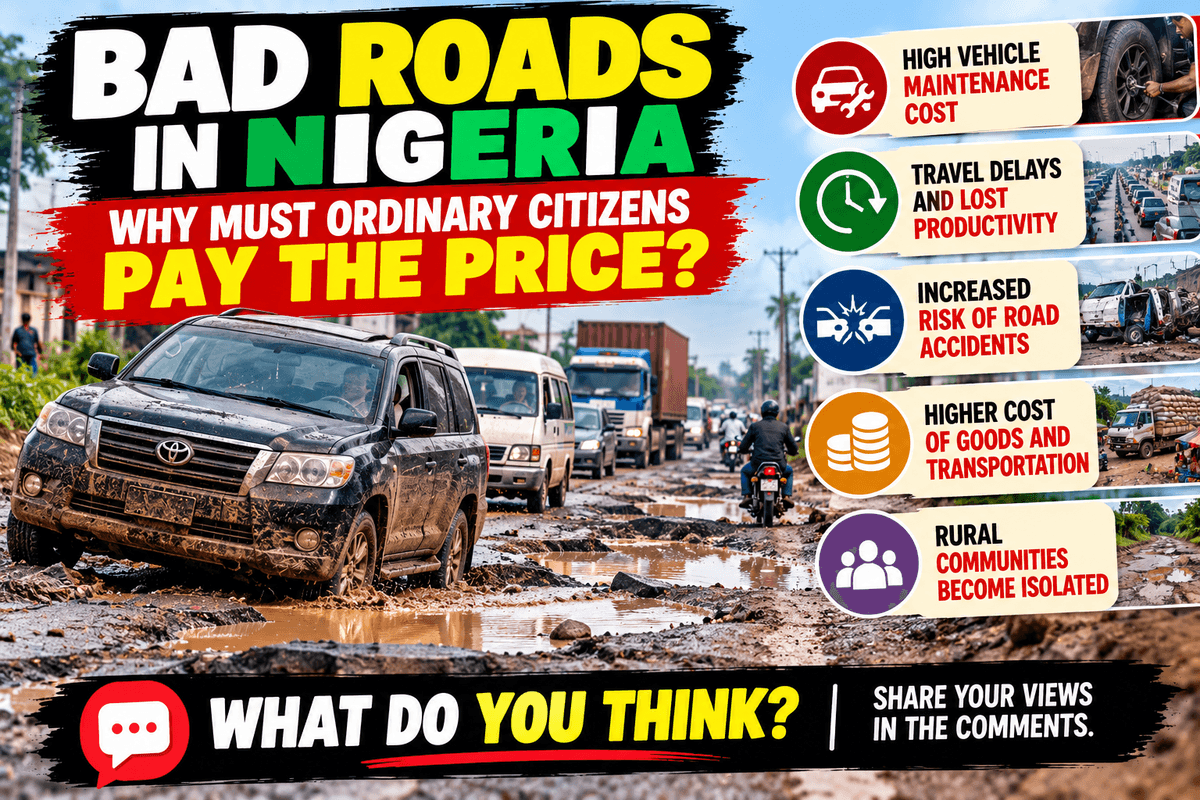
Imagine travelling from one state to another in Nigeria. You leave home early, hoping to arrive at your destination on time. But halfway through the journey, your vehicle encounters a road filled with potholes, broken sections and deep depressions filled with rainwater.
The driver slows down to avoid damaging the vehicle. Passengers become uncomfortable, traffic builds up, and what should have been a three-hour journey becomes a six-hour struggle.
For some travellers, the experience does not end with delays. Vehicles break down, tyres get damaged, and passengers may face dangerous situations while trying to navigate difficult sections of the road.
Unfortunately, many Nigerians are familiar with these experiences.
This raises an important question: Why should citizens continue to suffer the consequences of bad roads in a country where road infrastructure is essential to economic growth and everyday life?
Bad Roads Are More Than an Inconvenience
When people discuss bad roads, the conversation often focuses on potholes and damaged vehicles. However, the consequences can extend much further.
1. The Cost of Transportation Increases
Commercial drivers spend money repairing suspensions, replacing tyres and maintaining vehicles damaged by poor road conditions.
These expenses can eventually affect transport fares and the prices of goods.
When transporting food, building materials or other essential products becomes more expensive, consumers may also feel the impact.
In this way, poor road infrastructure can contribute to the financial difficulties experienced by ordinary households.
2. Businesses Lose Time and Money
Roads connect markets, farms, factories, offices and communities.
When roads are difficult to navigate, businesses may experience delivery delays, increased operating costs and reduced productivity.
Farmers may struggle to transport perishable produce to markets before it spoils. Small business owners may spend more money moving their goods than they would on a properly maintained route.
For businesses operating on limited budgets, these additional costs can make survival more difficult.
3. Road Safety Becomes a Concern
Damaged roads can force drivers to make sudden manoeuvres, slow down unexpectedly or move into the path of oncoming traffic to avoid potholes.
During rainfall, water may conceal the depth of damaged sections, making them even more difficult to navigate.
Although road crashes have multiple causes, poor road conditions can create additional hazards for motorists, cyclists and pedestrians.
A road should help people reach their destinations safely, not expose them to avoidable dangers.
4. Rural Communities Can Become Isolated
The effects of poor roads can be particularly difficult for rural communities.
Farmers may struggle to reach markets, students may find travelling to school more difficult, and residents may face delays when seeking medical care.
When communities have limited access to reliable transportation routes, their opportunities for economic and social development can also be affected.
Road infrastructure is therefore not simply about making journeys comfortable. It can influence access to education, healthcare, employment and essential services.
Who Should Take Responsibility?
Maintaining public roads requires planning, funding, technical expertise and effective supervision.
Depending on the road, responsibility may rest with the federal, state or local government. This makes it important to identify the relevant authority before demanding action.
However, responsibility should not end with constructing a road.
Roads require regular inspections, drainage maintenance, timely repairs and proper management of public funds.
Where construction projects are undertaken, citizens should be able to ask reasonable questions:
Was the project completed according to the required standards?
Were appropriate materials used?
Is there a maintenance plan?
Were public funds properly managed?
If a road has deteriorated, which authority is responsible for repairing it?
These questions are not necessarily political attacks. They are legitimate concerns about public infrastructure and accountability.
Should Citizens Remain Silent?
Citizens have a role to play in demanding better infrastructure.
They can document road conditions, submit complaints to the appropriate authorities, participate in community discussions and request updates on announced road projects.
Community organisations and the media can also help bring attention to neglected roads and follow up on commitments made by responsible institutions.
At the same time, public criticism should be based on accurate information. Not every damaged road has the same cause, and some roads may deteriorate because of flooding, poor drainage, heavy traffic or inadequate maintenance.
Understanding these factors can help communities demand solutions that address the actual problems rather than temporary repairs that fail after a short period.
Nigeria Needs Roads That Serve the People
Good roads can support economic activity, improve access to essential services and make travelling easier and safer.
But achieving these benefits requires more than promises or occasional repairs.
It requires responsible planning, quality construction, regular maintenance and accountability from the institutions responsible for public infrastructure.
Ordinary citizens should not have to accept damaged roads as a permanent feature of everyday life.
The real question is not whether Nigeria needs good roads. It is how public authorities can ensure that road infrastructure is properly constructed, maintained and made to serve the people.
THE BIG QUESTION
Imagine you are travelling on a road that has remained in poor condition for several years, despite repeated public complaints.
Who do you think should bear the greatest responsibility: the government, the contractors responsible for construction, the agencies responsible for maintenance, or a combination of all three?
And here is another question:
If you were given the opportunity to fix one major road problem in Nigeria, would you prioritise pothole repairs, proper drainage, road expansion, quality construction or regular maintenance? Why?
Share your experiences and opinions in the comments. If you have travelled on a particularly bad road, tell us the state or route and how the condition affects people who use it.
