 Writers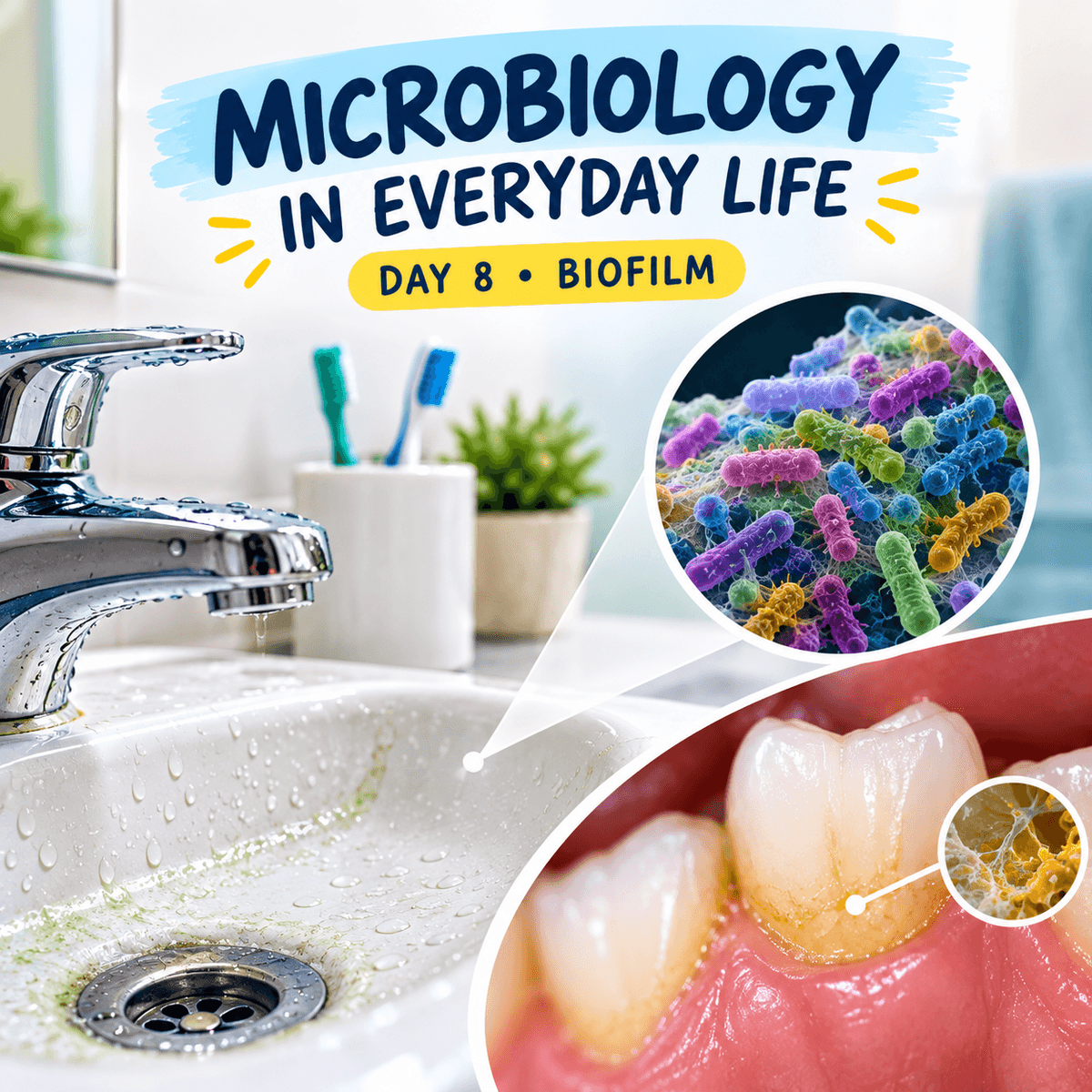
Microbiology in Everyday Life — Day 8
That Slimy Layer Is More Interesting Than You Think
Have you ever cleaned your bathroom sink, only to notice a slippery layer around it a few days later?
Or brushed your teeth in the morning and still felt something slightly sticky on them?
Maybe you have noticed a slimy layer inside a water container that wasn't cleaned for a while.
Most of us simply think:
“This place is dirty.”
But as a microbiologist, I would probably ask a different question:
“What is living here?”
And that question leads us into one of the most interesting parts of microbiology.
Meet the biofilm
Microorganisms don't always live as individual cells floating around on their own.
Sometimes, they attach themselves to a surface and live together as a community.
They can produce substances that help them stick to the surface and surround themselves with a protective matrix.
This organised microbial community is called a biofilm.
Think of it as a tiny microbial neighbourhood.
The organisms are not necessarily just scattered randomly. They can attach, multiply, interact with one another and become embedded in the material they produce.
And the fascinating part?
You may encounter biofilms without ever realizing it.
Your mouth is one example
That sticky film that develops on your teeth is called dental plaque.
It isn't simply “food stuck on your teeth.”
Dental plaque is a microbial biofilm containing communities of microorganisms attached to the tooth surface.
This doesn't mean every microorganism in your mouth is harmful.
Our mouths naturally contain many different microorganisms, and the microbial community can exist in a relatively balanced state.
Problems can arise when that balance changes.
For example, frequent exposure to fermentable sugars can create conditions that favour acid-producing and acid-tolerant bacteria within dental plaque, contributing to tooth decay.
So that small amount of plaque you notice on your teeth is actually part of a much bigger microbial story.
Biofilms are not only found in the mouth
They can develop on many surfaces.
Wet environments are particularly important.
Microorganisms can form biofilms inside water pipes, around faucets and sinks, and on other continuously moist surfaces.
They can also occur on medical devices and other surfaces in healthcare environments.
This is one reason microbiologists and healthcare professionals take biofilms seriously.
Once microorganisms become established in a biofilm, their behaviour and response to their environment can differ from that of freely suspended cells. The surrounding matrix can also make them more difficult to remove or control.
So why doesn't ordinary cleaning always feel like enough?
Have you ever wiped a wet surface and thought it was clean, only to notice that slippery feeling again later?
Part of the reason is that microorganisms can attach to surfaces and build communities.
A biofilm isn't simply a collection of loose cells waiting to be wiped away.
It is an organised community embedded in material produced by microorganisms and their environment.
That is why removing visible dirt and controlling microorganisms are related, but they are not exactly the same thing.
And this is where microbiology changes the way you look at ordinary life.
A sink is no longer just a sink.
A tooth is no longer just a tooth.
A water pipe is no longer just a pipe.
Each can become a surface where microscopic life attaches, grows and interacts.
The bigger lesson
One of the things I love about microbiology is that it teaches us to look again at things we think we already understand.
You see a slippery layer.
A microbiologist sees a possible microbial community.
You see plaque.
A microbiologist sees a complex ecosystem.
You see a wet pipe.
A microbiologist knows that microorganisms may have found a place to attach and survive.
The invisible world is constantly interacting with the visible one.
And sometimes, it is happening right in front of us.
Today's takeaway
Microorganisms don't always live alone. Sometimes, they build communities on surfaces and these communities are called biofilms.
Dental plaque is one everyday example.
So the next time you brush your teeth, clean your sink or wash a water container, remember:
You are not just cleaning a surface.
You may be disrupting an entire microscopic neighbourhood.
And that is microbiology in everyday life.
Next stop: How do bacteria communicate when they are living together in these tiny communities?
