 Writers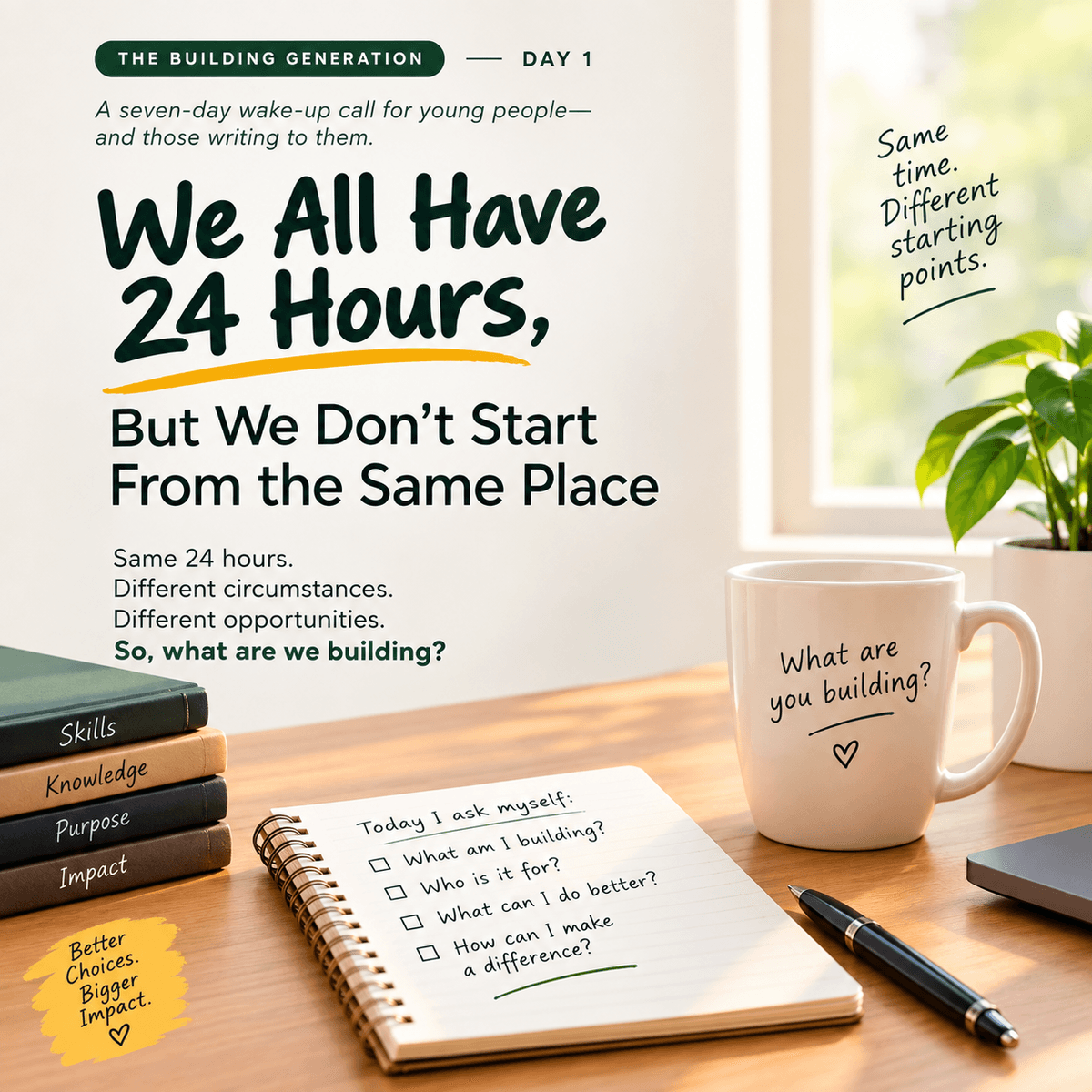
We All Have 24 Hours, But We Don't Start From the Same Place
Someone will eventually tell you,
“We all have the same 24 hours.”
It sounds wise.
It is also incomplete.
Yes, you and I wake up with the same twenty-four hours in a day. But we don't wake up with the same circumstances.
One person wakes up with a stable home, internet connection, supportive parents, good education, someone who can make a phone call on their behalf and a network of people who know people.
Another wakes up thinking about what to eat.
Someone has a laptop.
Someone is borrowing a phone.
Someone has the freedom to spend three years learning a skill without worrying about where the next school fee will come from.
Someone else is working and studying at the same time.
Someone has been told since childhood, “You can become anything.”
Another has spent years hearing, “People like us don't do those things.”
Same twenty-four hours.
Different realities.
This is not an excuse to give up. Neither is it a reason to look at someone else's progress and conclude that they are simply more hardworking than you.
Sometimes, we need to be honest enough to admit that opportunity is not distributed equally.
In Nigeria, for example, geography, poverty, gender, access to education and digital access can influence the opportunities available to young people. UNICEF's recent analysis of Nigerian children and young people points to significant inequalities and warns that unequal access to technology and other opportunities can deepen existing gaps.
But here is where I want the conversation to become uncomfortable.
If we know this, what are we building?
Because complaining about the world is easy.
Building something better is harder.
We complain that young people don't have opportunities.
But are we creating opportunities?
We complain that people don't read.
But what are we writing?
We complain that young people are confused.
What are we teaching?
We complain that society is becoming selfish.
Where are we demonstrating generosity?
We complain that the next generation is losing direction.
What are we putting in front of them?
And perhaps most importantly:
What kind of world are our actions preparing for the person who comes after us?
I think young people need to stop asking only, “What can I get?”
We also need to ask, “What can I build?”
Build a skill.
Build character.
Build a business.
Build knowledge.
Build a community.
Build a useful platform.
Build a healthy relationship.
Build something that solves a problem.
Build something that makes another person's journey slightly easier.
And if you are a writer, build with your words.
Because writing is not just filling a page.
Every time we publish something, we are putting an idea into somebody else's head.
A young person may read something we wrote today and begin thinking differently about their life tomorrow.
That is a responsibility.
The World Bank's 2026 State of the Nigerian Youth report examines barriers around education and skills, employment, financial and digital inclusion, health and civic engagement. Meanwhile, recent youth-development work has emphasized that young people need pathways that connect skills to real opportunities and meaningful participation not merely visibility.
So perhaps this week should not be about telling young people to “do more.”
Perhaps it should be about asking better questions.
What are we building?
Who are we building it for?
Who is being left out?
What knowledge are we sharing?
What problems are we solving?
What are we normalising?
What are our children going to inherit from us besides complaints about how difficult life was?
Because one day, our generation will become the older generation.
And the people coming behind us will look at what we left behind.
They may ask:
What did you do when you realised things were not working?
Did you only complain?
Did you leave?
Did you adapt?
Did you build?
I don't have all the answers.
You probably don't either.
But maybe that is exactly where we should begin.
Not with pretending we have figured everything out.
With asking better questions.
So, young person reading this:
Don't only ask whether you are succeeding.
Ask yourself
What are you building?
And to every writer reading this:
Don't only ask whether people are reading your work.
Ask
What is your writing building inside the people who read it?
Because perhaps changing the world doesn't always begin with something enormous.
Sometimes it begins with one person thinking differently.
Then another.
Then another.
And perhaps, if we keep building, we may eventually look around and realise that we didn't just write about a better world.
We helped build one.
