Writers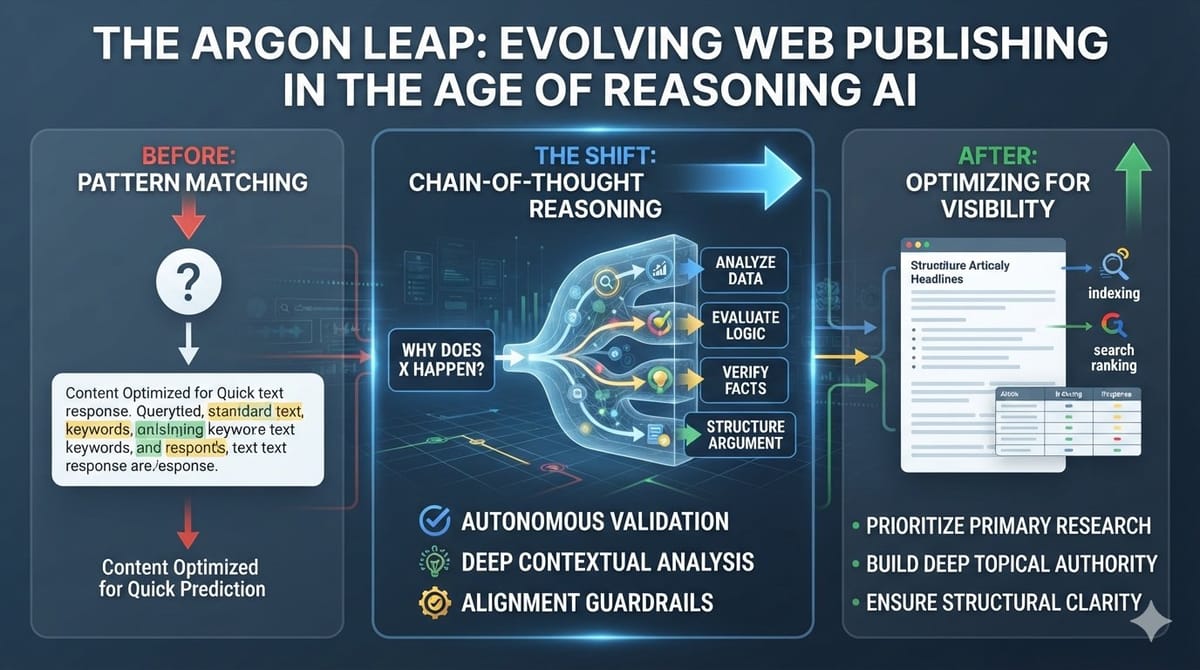
There is a paradigm shift underway in the architecture of information summarization and presentation, which directly impacts the opportunities for independent writers, bloggers, and publishers. The key turning point for this development is the appearance of reasoning in the architecture of consumer AI. The implications of this leap – from pattern recognition to reasoning with visible chain-of-thought validation – for the wider search ecosystem are profound, and the emerging opportunities for content creators are equally significant.
In order to fully appreciate the impact of this architectural turn on the quality of discourse around information discovery and presentation, it is necessary to take a closer look at the engineering nuances of this architectural shift. Prior to the introduction of new foundational models, such as Gemini 4 Argon by Google, the dominant paradigm in pre-trained language models was geared exclusively towards text prediction. This means that, given a textual prompt, the model would select the most statistically probable word, and repeat this process until the desired output length was reached. While this approach produces coherent results, it does not always reflect the best practices in reasoning.
The new generation of large language models (LLMs) is designed to incorporate an additional layer of reasoning, which simulates the thought process that leads to the formulation of a response. This addition takes computation power and time, but it allows the model to emulate a more natural flow of thinking. Notably, a significant number of safety and alignment guardrails are also integrated into this stage of processing. In essence, before formulating a response, the model reviews and validates each step of the thought process, verifying the accuracy of factual claims and evaluating the logical validity of inferences and assumptions. This process can be interrupted at any point, if the model’s internal safety protocols raise any red flags. As a result of this turnaround, it becomes significantly harder to “trick” the AI into endorsing unsubstantiated claims, presenting questionable ideas as facts, or advancing logically unsound arguments.
From the perspective of independent writers and publishers, this architectural turn creates two new opportunities. First of all, the quality threshold for discoverability is now determined by the ability to present information in a way that reflects the depth and nuance of thought. Web publishers and bloggers are often browsed by AI-powered assistants, which scan the content for ideas and insights, and use them to train their own recommendation and search functions. As such, superficial explications and commonplaces will no longer be adequate to the demands of content discovery. Articles and blog posts that attempt to explain the how and why of a particular development, rather than simply reporting on the what and when, will fare better in terms of visibility.
Second, the new LLMs favor creators who utilize semantic formatting and modular design to structure their thoughts and ideas. Well-structured prose, with frequent use of subheadings, summarizing paragraphs, comparisons and contrasts, and other devices that highlight the logical flow of the text, will be rewarded by the new algorithms. This is because LLMs with enhanced reasoning functions need to parse the information provided by a given source, and identify the key takeaways. Semantic formatting allows the LLM to quickly scan the content and extract the relevant concepts, facts, and statistics. As a result, writers and publishers that value clarity and logical flow are in an excellent position to capitalize on this new turn in AI development.
The rise of the LLMs with enhanced reasoning functions, such as Google’s Gemini 4 Argon, is an opportunity for web publishers and bloggers. The new content discovery paradigm favors creators that produce high-quality, well-structured content. In particular, the new LLMs can be leveraged to promote content types that are conducive to detailed explanation and analysis. The importance of semantic formatting is also on the rise, as it allows both regular users and LLMs to quickly grasp the key points of an article or blog post. From now on, independent creators must embrace the power of their voice to deliver high-quality, trustworthy writing that prioritizes nuance and subtlety.
Foundational Research
Google Research Blog (Chain-of-Thought): https://research.google
arXiv Research Paper: https://arxiv.org
Gemini 4 Argon Launch Detail: https://blog.google