Writers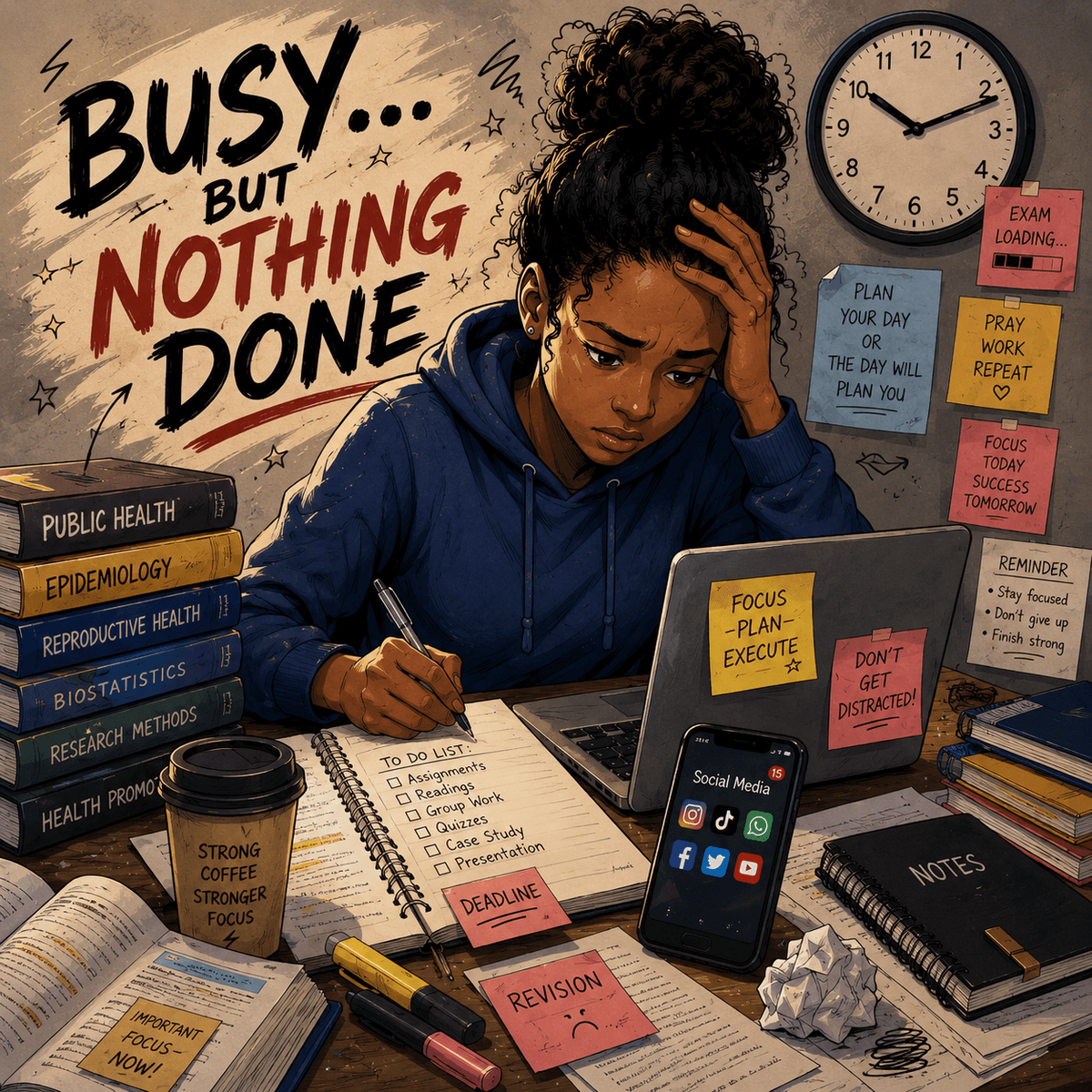
Have you ever had one of those days when you were busy from morning until night, yet when the day finally ended, you could hardly point to what you had accomplished?
For many students, this is a familiar experience. A student may attend school, return home, eat, help with household chores, respond to messages, check social media and finally remember that an assignment is still waiting. By then, tiredness has already taken over.
The problem is not always that students have too little time. Sometimes, it is that their time is not being managed properly.
Being busy and being productive are not the same thing. A student can spend several hours moving from one activity to another and still leave the most important tasks unfinished. Learning how to manage time can make school responsibilities less stressful and help students make better use of their day.
Productivity is not about filling every minute of the day with activities. It is about making meaningful progress on the things that matter.
For example, a student may sit with a textbook for two hours but spend much of that time checking their phone. Another student may study for one focused hour without distractions and understand much more. This shows that the amount of time spent on a task is not the only thing that matters. Attention, planning and consistency also play important roles.
Students should occasionally ask themselves, “Am I really making progress, or am I simply keeping myself busy?” That simple question can reveal where valuable time is being lost.
One of the simplest ways to manage time is to have a plan before the day becomes crowded. A student does not necessarily need an expensive planner. A notebook, calendar or phone can be enough. What matters is identifying the major things that need to be done and deciding when they should be completed.
For instance, after school, a student may have an assignment, household responsibilities and other activities to handle. Instead of trying to remember everything, these activities can be arranged on a simple daily schedule. Planning ahead also reduces the chance of reaching bedtime and suddenly realizing that an important assignment has not been touched.
Large assignments can be another reason students procrastinate. When a lengthy assignment is viewed as one huge task, it can feel overwhelming. A student may think, “I have to finish all of this,” and decide to postpone it because the work seems too difficult to begin.
Breaking the assignment into smaller tasks can make a significant difference. A student could research the topic first, write the introduction later, complete the main sections one at a time and handle the references separately. Instead of worrying about the entire assignment at once, the focus becomes the next step.
This approach can make large academic tasks easier to start and can reduce the pressure that often comes with last-minute work.
Distractions can also quietly consume a student's time. You may sit down intending to study, but after receiving a message, you pick up your phone. One message leads to another, and before you realize it, a significant part of your study time has disappeared.
The solution is not necessarily to avoid your phone completely. Instead, students can create periods when distractions are deliberately put aside. When it is time to study, focus on studying. When working on an assignment, give the assignment your attention. After completing an important task, take a break and attend to other things.
Focusing on one task at a time can make work feel more manageable and help students accomplish more without feeling as though they have been working all day.
Students also need to remember that schoolwork is only one part of their lives. Some have household chores, family responsibilities, religious activities, part-time work or other commitments. These responsibilities should be considered when creating a daily schedule.
A realistic plan should reflect a student's actual life rather than an ideal routine that is impossible to maintain. A student who returns home from school in the afternoon, for example, may need time to eat, rest briefly, complete an assignment and help at home.
Trying to force all these activities into unrealistic time limits can create unnecessary frustration. Good time management means making room for the things that genuinely need attention while still protecting time for important academic work.
Rest should also have a place in the plan. Being productive does not mean working every minute of the day.
After attending school and completing academic or household responsibilities, students need time to recover. A short break can help the mind reset and make it easier to concentrate on the next task.
Sometimes, students feel guilty whenever they take a break because they believe they should always be doing something. However, constantly working without adequate rest can make concentration more difficult and make even simple tasks feel exhausting.
Rest does not have to mean wasting an entire afternoon. It could be sitting quietly, talking with family, listening to music or doing something enjoyable for a short period. The goal is not to avoid responsibility but to create a healthy balance between work and relaxation.
There is also no perfect daily routine that works for every student. One student may have plenty of free time after school, while another may have several responsibilities at home. Copying someone else's routine exactly may therefore not produce the same results.
Instead, students should pay attention to how they normally spend their day and identify where changes are needed. A useful routine should provide structure while remaining flexible enough to handle unexpected events.
If something important takes longer than expected, the entire day should not be considered a failure. The schedule can be adjusted and the remaining tasks rearranged. What matters is returning to the plan rather than giving up completely.
Consistency is more valuable than creating a perfect timetable that can only be followed for two days.
Ultimately, time management is not about trying to accomplish everything in one day. It is about understanding what is important and giving those things the attention they deserve.
A student who plans ahead, breaks large assignments into smaller tasks, reduces unnecessary distractions, considers other responsibilities and allows time for rest can make better use of each day.
Sometimes, the reason a student feels unproductive is not because there are not enough hours in the day. The real problem may be that those hours have not been given direction.
Being busy can make you tired, but being purposeful can help you make progress.