Writers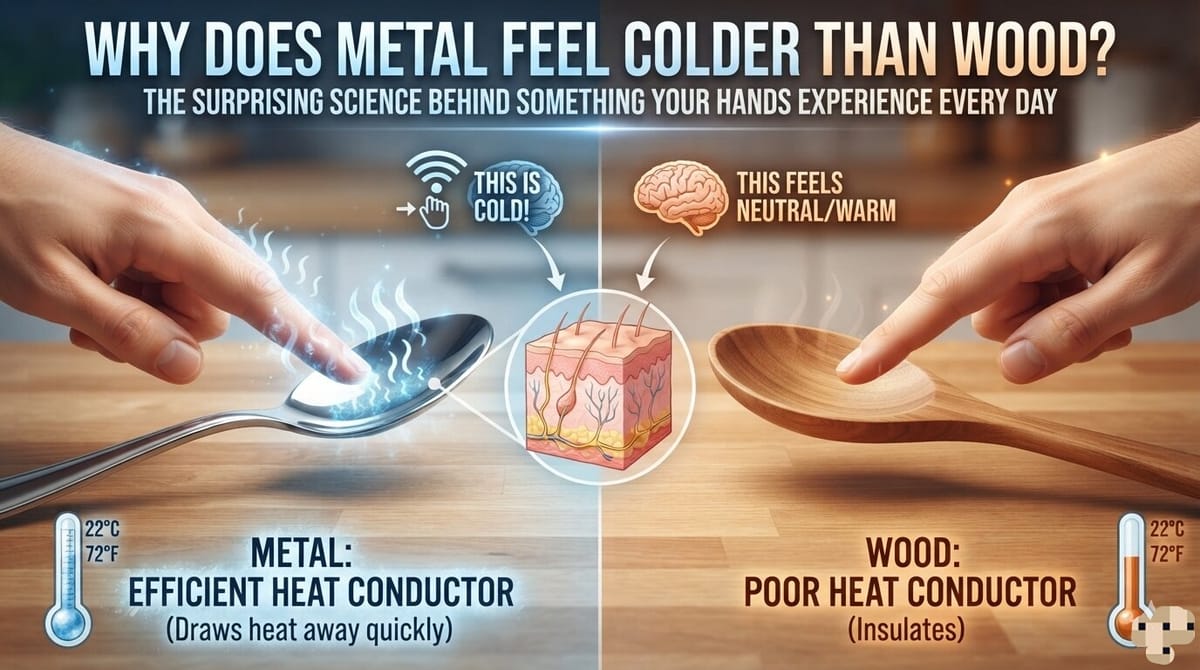
The Surprising Science Behind Something Your Hands Experience Every Day
Place a metal spoon and a wooden spoon together in the same room for a period of time.
Then, touch both of them.
The metal spoon feels cold.
The wooden one does not.
Even though both may be at precisely the same room temperature, your hand perceives a substantial difference!
What causes metal to feel colder than wood?
The remarkably fascinating explanation relates to the physics of heat transfer.
🔥 TEMPERATURE IS NOT THE SAME AS HOW SOMETHING FEELS
When you observe an object, its temperature allows you to determine how warm or cool it is.
However, when you touch an object, your nerves are not directly detecting the temperature.
They detect the rate of heat transfer in their immediate vicinity.
If your hand is warmer than the object you are touching, heat will move from your hand to the object.
The speed at which this happens influences how hot or cold something feels.
The more rapidly something conducts heat away from your skin, the colder it feels.
Metal conducts heat effectively.
⚙️ METAL IS VERY GOOD AT MOVING HEAT
Numerous metals are highly effective conductors.
This means that they tend to draw heat away from your hand when you touch them.
Your nerves detect that sensation and transmit the signal to your brain, which declares “THIS IS COLD!”
Wood does not function as a good conductor.
Wood does not conduct heat away from your hand nearly as effectively.
Consequently, your hand does not lose as much heat when you touch a wooden object.
As a result, it does not feel as cold as the metal does.
🪵 TRY THIS SIMPLE EXPERIMENT
Walk around your house.
Locate a metal object and a wooden object that have remained in the same room for some time.
Touch both of them.
You may now observe that the metal feels colder.
Yet if you were to place a thermometer on them, they might be at nearly the exact same temperature.
Your hand informed you about the transfer of heat, not about the temperature of the objects.
Everyday applications are everywhere!
The same physics principle accounts for why a tile floor feels colder than a carpet, why a metal chair feels colder than a wooden chair, and why an ice-cold metal soda can hurts your fingers!
In all those examples, carpet, wood, and metal can all be at the same room temperature.
However, the manner in which they transfer heat differs.
That is also why we use certain materials to build homes, cook our food, and keep our electronics from melting.
🔥 BUT THERE IS ANOTHER SIDE TO THE STORY
The heat-conducting properties of metals and other materials can be advantageous.
Cooking pans are typically made of metals.
The explanation lies in the fact that efficient heat transfer proves advantageous for cooking.
Numerous machines and appliances employ heat-conducting materials and techniques in order to maintain cool temperatures.
The very property that causes metal to feel cold when touched renders it exceptionally valuable in our everyday lives.
🧠 YOUR SENSES ARE GIVING YOU INFORMATION—BUT CONTEXT MATTERS
The encounter one has when touching a piece of metal imparts an important lesson.
Valuable though they may be, our senses can only convey a limited amount of information.
When your hand indicates that the metal is colder, it is accurate.
Yet your common sense suggests that the metal must be at a lower temperature, which is not necessarily true.
This is precisely why scientists conduct experiments.
Employing the scientific method enables us to determine exactly what is occurring in a given situation.
This constitutes a minor illustration of the critical thinking that renders humanity so successful.
🌍 AN ETHICAL REFLECTION
There is much to be gained from this modest science experiment.
A first impression, although occasionally helpful, is not necessarily an accurate depiction of reality.
Acquiring the ability to think critically and to pose questions constitutes an essential life skill.
It is not solely within science that context and critical thinking hold significance.
Such skills prove valuable across every domain of life.
❓ QUICK QUESTIONS
Why does metal feel colder than wood?
Because metal typically conducts heat away from your skin more rapidly, which causes your hand to lose heat at a faster rate.
Must metal and wood necessarily differ in temperature?
No, they may be essentially the same temperature.
Does wood genuinely generate heat?
No, it merely does not conduct heat away as rapidly as metal does.
Why does carpet feel warmer to the touch than a tile floor?
Carpet generally serves as a poorer conductor of heat than tile.
📌 KEY TAKEAWAYS
• A sensation of coldness does not invariably indicate a lower temperature.
• Heat is transferred from warmer objects to cooler ones.
• Metals typically conduct heat with considerable efficiency.
• Wood and numerous insulating materials conduct heat more slowly.
• The skin detects heat transfer, whereas a thermometer measures temperature.
• Ordinary experiences can expose unexpectedly profound scientific principles.
CONCLUSION
The next time you touch a piece of metal and tell yourself “this is colder than the wood,” reconsider.
The metal may not in fact be colder.
Instead, it conducts heat away from your hand, which makes it feel colder than the wood.
This simple experience demonstrates that science is frequently concealed in plain sight within our daily lives.
🌟 WRITERS ARENA QUESTION
What other everyday experience have you observed that appears simple—yet may possess an unexpected scientific explanation?
SOURCE
OpenStax — College Physics 2e, “Temperature”
https://openstax.org/books/college-physics-2e/pages/13-1-temperature