Writers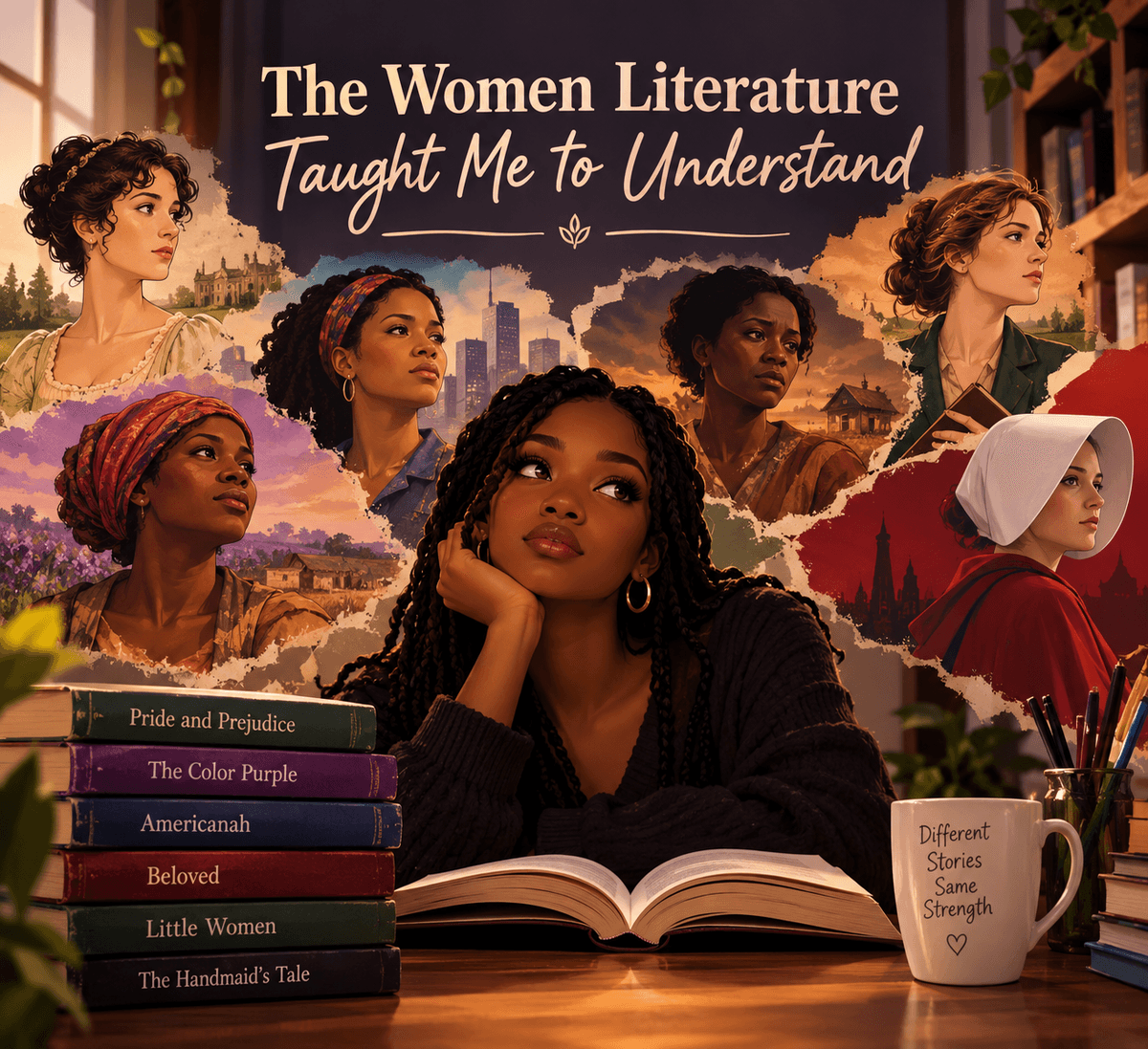
The Women Literature Taught Me to Understand
Literature has introduced me to women I could never have met in ordinary life: women who loved fiercely, suffered quietly, rebelled courageously, and sometimes made mistakes that felt painfully human. Through their stories, I learned that womanhood is not one experience or a single definition. It is a collection of choices, struggles, dreams, contradictions, and acts of courage.
Jane Austen’s Elizabeth Bennet, from Pride and Prejudice, taught me the importance of intellectual independence. Elizabeth refuses to marry merely for security or social approval. Her wit and confidence remind me that a woman’s mind is not an accessory; it is one of her greatest possessions. She taught me that knowing oneself can be more valuable than being accepted by others.
In The Color Purple, Alice Walker’s Celie revealed another dimension of womanhood: survival and transformation. Celie begins as a woman whose voice has been repeatedly silenced, yet she gradually discovers her worth through friendship, sisterhood, and self-determination. Her journey taught me that finding one’s voice can be a form of rebirth, and that even after years of oppression, a woman can reclaim her life.
Chimamanda Ngozi Adichie’s Ifemelu, from Americanah, taught me about identity. As an immigrant navigating race, relationships, culture, and belonging, Ifemelu refuses to make herself smaller to fit other people’s expectations. Through her, I learned that womanhood can involve negotiating several identities at once while still protecting the right to define oneself.
Then there is Sethe in Toni Morrison’s Beloved, whose story confronts me with the unbearable complexity of motherhood. Sethe’s choices emerge from slavery, terror, and an overwhelming desire to protect her children. She taught me that motherhood cannot always be understood through simple judgments of right and wrong. Sometimes, love exists within circumstances so brutal that ordinary morality becomes difficult to apply.
Jo March, from Louisa May Alcott’s Little Women, taught me that ambition does not make a woman less feminine. Jo writes, dreams, earns, argues, and refuses to surrender her independence simply because society expects marriage to be every woman’s ultimate achievement. Her determination showed me that women deserve ambitions that belong entirely to themselves.
Finally, Offred in Margaret Atwood’s The Handmaid’s Tale taught me the value of remembering. In a society determined to erase women’s identities, her memories become an act of resistance. She reminds me that controlling women often begins with controlling their voices, histories, bodies, and choices.
These women are separated by time, culture, circumstance, and personality, yet together they have taught me something profound: womanhood is not about being endlessly strong, perfectly selfless, or universally agreeable. It is about possessing the courage to remain human in a world that repeatedly demands conformity.
Literature taught me to understand women not as symbols, but as complete people. Through Elizabeth, Celie, Ifemelu, Sethe, Jo, and Offred, I learned that every woman carries a story worth hearing—and that understanding womanhood begins when we finally listen. Their voices continue to remind me that complexity is not weakness but humanity.